March 25, 2007
-
March 25 is a big feast day for the Greek Orthodox, it is Annunciation, one of the earliest Christian feasts and Greek Independence day, the Greeks purposely choose this day to fight for their independence from the Ottoman Turks.
MARCH 25th — CELEBRATION OF GREEK INDEPENDENCE DAYThe Annunciation of our Most Holy Lady, the Theotokos and Ever-Virgin Mary
The Feast of the Annunciation is one of the earliest Christian feasts, and was already being celebrated in the fourth century. There is a painting of the Annunciation in the catacomb of Priscilla in Rome dating from the second century. The Council of Toledo in 656 mentions the Feast, and the Council in Trullo in 692 says that the Annunciation was celebrated during Great Lent.
The Greek and Slavonic names for the Feast may be translated as “good tidings.” This, of course, refers to the Incarnation of the Son of God and the salvation He brings. The background of the Annunciation is found in the Gospel of St Luke (1:26-38). The troparion describes this as the “beginning of our salvation, and the revelation of the eternal mystery,” for on this day the Son of God became the Son of Man.
There are two main components to the Annunciation: the message itself, and the response of the Virgin. The message fulfills God’s promise to send a Redeemer (Genesis 3:15): “I will put enmity between you and the woman, between your seed and her seed; he shall crush your head, and you shall lie in wait for his heel.” The Fathers of the Church understand “her seed” to refer to Christ. The prophets hinted at His coming, which they saw dimly, but the Archangel Gabriel now proclaims that the promise is about to be fulfilled.
We see this echoed in the Liturgy of St Basil, as well: “When man disobeyed Thee, the only true God who had created him, and was deceived by the guile of the serpent, becoming subject to death by his own transgressions, Thou, O God, in Thy righteous judgment, didst send him forth from Paradise into this world, returning him to the earth from which he was taken, yet providing for him the salvation of regeneration in Thy Christ Himself.”
The Archangel Gabriel was sent by God to Nazareth in Galilee. There he spoke to the undefiled Virgin who was betrothed to St Joseph: “Hail, thou who art highly favoured, the Lord is with thee: blessed art thou among women. And, behold, thou shalt conceive in thy womb, and bring forth a son, and shalt call his name Jesus. He shall be great, and shall be called the Son of the Most High: and the Lord God shall give unto him the throne of his father David: And he shall reign over the house of Jacob for ever; and of his kingdom there shall be no end.”
In contrast to Eve, who was readily deceived by the serpent, the Virgin did not immediately accept the Angel’s message. In her humility, she did not think she was deserving of such words, but was actually troubled by them. The fact that she asked for an explanation reveals her sobriety and prudence. She did not disbelieve the words of the angel, but could not understand how they would be fulfilled, for they spoke of something which was beyond nature.
Then said Mary unto the angel, How shall this be, seeing I know not a man?” (Luke 1:34).
“And the angel answered and said unto her, The Holy Ghost shall come upon thee, and the power of the Most High shall overshadow thee: therefore also that which shall be born of thee shall be called the Son of God. And, behold, thy cousin Elisabeth hath also conceived a son in her old age: and this is the sixth month with her, who was called barren. For with God nothing shall be impossible.’ And Mary said, ‘Behold the handmaid of the Lord; be it unto me according to thy word.’ And the angel departed from her” (Luke 1: 35-38).”
In his Sermon 23 on the day of the Annunciation, St Philaret of Moscow boldly stated that “the word of the creature brought the Creator down into the world.” He explains that salvation is not merely an act of God’s will, but also involves the Virgin’s free will. She could have refused, but she accepted God’s will and chose to cooperate without complaint or further questions.
The icon of the Feast shows the Archangel with a staff in his left hand, indicating his role as a messenger. Sometimes one wing is upraised, as if to show his swift descent from heaven. His right hand is stretched toward the holy Virgin as he delivers his message.
The Virgin is depicted either standing or sitting, usually holding yarn in her left hand. Sometimes she is shown holding a scroll. Her right hand may be raised to indicate her surprise at the message she is hearing. Her head is bowed, showing her consent and obedience. The descent of the Holy Spirit upon her is depicted by a ray of light issuing from a small sphere at the top of the icon, which symbolizes heaven. In a famous icon from Sinai, a white dove is shown in the ray of light.
There are several famous icons of the Annunciation. One is in the Moscow Kremlin in the church of the Annunciation. This icon appeared in connection with the rescue of a prisoner by the Mother of God during the reign of Ivan the Terrible. Another is to be found in the Dormition Cathedral in Moscow (July 8). It was originally located in Ustiug, and was the icon before which St Procopius the fool (July 8) prayed to save the city from destruction in 1290. One of the most highly revered icons in Greece is the Tinos icon of the Annunciation (January 30).
The Annunciation falls during Lent, but it is always celebrated with great joy. The Liturgy of St Basil or St John Chrysostom is served, even on the weekdays of Lent. It is one of the two days of Great Lent on which the fast is relaxed and fish is permitted (Palm Sunday is the other).~~~~~~~~~~~~~~~~~~~~~~~~~~~~~~~~~~~~~~~~~~~~~~~~~~~~~~~~~~~~~~~~~~~~~~~~~~~~~~~~~
By Anthony G. Ziagos, Sr.
Publisher, The Merrimack Journal
The celebration of Greek Independence Day on March 25th draws inspiration from one of the holiest days for Greek Orthodox Christians, the Annunciation of the Theotokos. This is the day that the Archangel Gabriel announced to Mary that she would bear a child. Bishop Germanos of Patras seized the opportunity by raising the banner of revolution, in an act of defiance against the Turks and marked the beginning of the War of Independence. Cries of Zito H Ellas and Eleftheria H Thanatos can still be heard today. These freedom fighters, or klephts as they were called, of Greece sacrificed much for their country. Kolokotronis, Nikitara, Karaiskakis, Bouboulina, and Mpotsaris are some of the heroes of the revolution.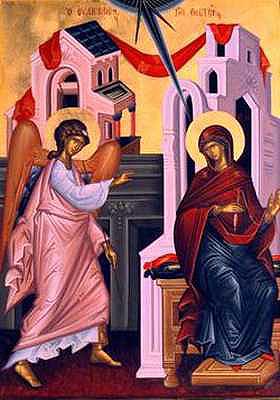
The struggle for independence was supported abroad by intellectuals of the day. In addition to the Secret Society of Friends (Filiki Etaeria) and the Sacred Band (Ieros Lohos) prominent world figures including Lord Byron of England, Daniel Webster and Dr. Samuel Gridly Howe of the United States raised the interest level among Europeans and Americans.
After centuries of unsuccessful uprisings and failure of the Ottoman Empire to assimilate and convert the Greeks, The War of Independence began in 1821 rising up against 400 years of occupation and oppression by the Ottoman Turks. The origin of the Turkish occupancy began in 1453 with the fall of Constantinople (currently referred to as Istanbul). All true and faithful Hellenes living in their occupied homeland reacted to the Turkish oppression and resisted the attempts to deprive the Greeks of their heritage, their freedom and their religion. During the dark years of the Ottoman occupation, thousands were killed and tortured for attending church or teaching their children culture, history and language. It was the Greek Orthodox Church that helped to retain their very identity by the institution of Crypha Scholia (Hidden Schools).
For eight years the fighting ensued, until 1829, when the Sultan Mahmud II, facing Soviet troops at the gates of Constantinople, accepted Greek independence with the Treaty of Andrianople. Copyright 2002 Middlesex Media Exchange
EDITOR’S NOTE: This article originally appeared in the March 2002 Edition of The Merrimack Journal which is distributed to 65,000 households in Eastern Massachusetts and Southern New Hampshire. They can be reached at www.merrimackjournal.com.
Greek FlagThe Greek Flag and the celebration of Greek Independence Day on March 25th are featured this month on the Hellenic Communication Service home page.
The flag of Greece has not changed since the revolution against the Ottoman Empire in 1821. The white cross in the upper left hand corner covering one fourth of the flag signifies the important role of the Greek Orthodox Church in the formation of the Hellenic Nation. The blue and white alternating stripes represent the sea and the relentless waves of the Aegean. According to legend, the Goddess of Beauty Aphrodite emerged from these waves. There are nine stripes representing each letter of the Greek word for freedom, Eleftheria. Copyright 2002 Middlesex Media Exchange

Comments (4)
Please pray for us especially right now.
http://hunsucker.blogspot.com/
This is my church’s name day! The Greek school put on a nice program of the kids saying/singing lots of stuff in Greek I can’t understand and dancing the cute way kids dance. It was nice.
It is our new Church’s name day, too!! Happy Feast Day, Tamara! :sunny: I imagine next year my children will be in the program and I will be posting pictures!
Happy Feast Day! And, Happy Independence Day, and new church’s Feast Day!