Month: April 2006

  • Jonah(5) just cried his little eyes out the last two nights.  He cried like his  heart was breaking. He wants to go to church with his beloved Baba’, like his older brothers, but isn’t quite ready to sit quietly for the long solemn Bridegroom services of Holy Week (and as the son of the priest he is very much being watched).


    Basil (8) and Nicholas(6) are doing really well though. This is Basil’s third Lent serving in the altar and he is able to follow along in the Holy Week book and from reports I receive for Mr. Les (Jenny’s dh) he is thriving in the altar! Glory Be to God!!


    They are all really looking forward to Holy Wednesday and Holy Unction tomorrow.  It is such a joy to see the children love the church as much as we do! My prayer is that they live a life in Christ always. I am so grateful for the richness of the Church that embraces all aspects of our life and keeps us rooted in  Christ through the Liturgical feasts and fasts of the year and all the sacraments. Year after the year the children grow in the faith as do we all, God willing! May they never stray but always have that longing to be in the Church and to know and love Christ more and more as they grow older.


    0303223.jpg

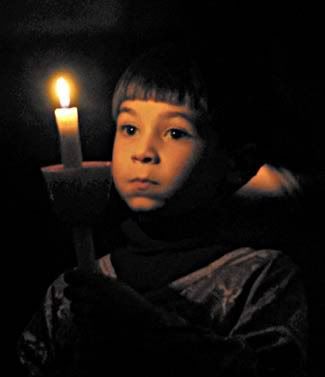
    This is a photo from Basil’s first night as an altar boy  he was 5 years old, this photo was taken by a local reporter doing a story on prayer; the photo was picked up by the AP.


  • Today is Great and Holy Tuesday


    On Tuesday
    : At Matins: Matthew 22: 15-23, 39. Condemnation of Pharisees, i.e. of the blind and hypocritical religion, of those who think they are the leaders of man and the light of the world, but who in fact “shut up the Kingdom of heaven to men.”

    At the Presanctified Liturgy: Matthew 24: 36-26, 2. The End again and the parables of the End: the ten wise virgins who had enough oil in their lamps and the ten foolish ones who were not admitted to the bridal banquet; the parable of ten talents “. . . Therefore be ye also ready, for in such an hour as ye think not the Son of Man cometh.” And, finally the Last Judgment.

    3.These Gospel lessons are explained and elaborated in the hymnology of these days: the stichiras and the triodia (short canons of three odes each sung at Matins). One warning, one exhortation runs through all of them: the end and the judgment are approaching, let us prepare for them: ‘”

    “Behold, O my soul, the Master has conferred on thee a talent Receive the gift with fear; Lend to him who gave; distribute to the poor And acquire for thyself thy Lord as thy Friend; That when He shall come in glory, Thou mayest stand on His right hand And hear His blessed voice: Enter, my servant, into the joy of thy Lord.” (Tuesday Matins)

    4. Throughout the whole Lent the two books of the Old Testament read at Vespers were Genesis and Proverbs. With the beginning of Holy Week they are replaced by Exodus and Job. Exodus is the story of Israel’s liberation from Egyptian slavery, of their Passover. It prepares us for the understanding of Christ’s exodus to His Father, of His fulfillment of the whole history of salvation. Job, the Sufferer, is the Old Testament icon of Christ. This reading announces the great mystery of Christ’s sufferings, obedience and sacrifice.

    5. The liturgical structure of these three days is still of the Lenten type. It includes, therefore, the prayer of St Ephrem the Syrian with prostrations, the augmented reading of the Psalter, the Liturgy of the Presanctified Gifts and the Lenten liturgical chant. We are still in the time of repentance for repentance alone makes us partakers of the Pascha of Our Lord, opens to us the doors of the Paschal banquet. And then, on Great and Holy Wednesday, as the last Liturgy of the Presanctified Gifts is about to be completed, after the Holy Gifts have been removed from the altar, the priest reads for the last time the Prayer of St Ephrem. At this moment, the preparation comes to an end. The Lord summons us now to His Last Supper.

    by THE VERY REV. ALEXANDER SCHMEMANN

  • Thank you Tracy for asking about the Holy Light .


    THE GREAT MIRACLE OF ORTHODOXY
    THROUGH THE CENTURIES


    TRUE ORTHODOXY, HOW MUCH OUR LORD JESUS CHRIST LOVES YOU, TO SENT HIS HOLY LIGHT AND BLAZE DOWN OUR HEARTS WITH HEAVENLY JUBILATION, LIGHT UP OUR MINDS AND RAISE OUR HOPE?


    Every Holy Saturday (Saturday of the Holy Week) at noon in the church of the Holy Sepulchre in Jerusalem recurs the GREAT MIRACLE OF THE HOLY LIGHT that stirs, affects rejoices and gives delight and faith to those who have the honour and blessing to be there for the ceremony of the Holy Light.

    I am appealing to every nation in this world knowing that I am a sinful person who is trying to improve his life through faith. The Most Merciful God made me worthy of seeing and touching His Holy Light. I feel obliged to describe with simplicity and devotion this shocking miracle, so that it is known to everyone who doesn’t know about it, and wish them to go and see it from near.


    DESCRIPTION OF THE MIRACLE


    1. PREPARATION OF THE HOLY SEPULCHRE: In the morning of the Holy Saturday, before the ceremony of the Holy Light takes place a very thorough check of the tomb and after that they seal it with a mixture of honey and wax that was prepared in the morning. This check takes place so that everyone is ascertain that there is nothing in the Holy Sepulchre that can cause a fire. After the tomb is sealed the authorities affix the wax with their seals (photo).

    All the other doctrines who have rights in the Holy Sepulchre show great interest in this procedure. This interest is by no means accidental. If for one year the miracle of the Holy Light doesn’t happen when the Greek Orthodox Patriarch performs the ceremony the other doctrines will try to undertake the precedence in the Holy Sepulchre.

    The checking begins at 10:00 and finishes at 11:00. While this takes place orthodox Arabs demonstrate in the church for the orthodox rights. It must be recorded that this pedantic check of the Holy Sepulchre watch representatives of the Armenians and of the other doctrines.


    2. THE CEREMONY OF THE HOLY LIGHT:The ceremony of the Holy Light takes place at 12:00 and constitutes of three stages: a. The Litany, b. The entry of the Patriarch in the Holy Sepulchre and c. The prayers of the Patriarch in order for the Holy Light to come out.

    Following the tradition, at noon of the Holy Saturday the Greek Orthodox Patriarch with his escort – archpriests, priests and deacons and the Armenian Patriarch – enter the Holy Sepulchre, while the bells strike mournfully. Before the entry of the Patriarch the keeper of the Sacristy of the Holy Temple carries the unsleeping oil lamp, (it is put out that day in order to turn on with the Holy Light). From the interior entry of the Temple of Apostle Jacob the Patriarch enters in the sanctuary and seats on the Patriarchal throne. Then the representatives of the Armenians, the Arabs, the Copts and others pass and kiss the hand of the Patriarch so that they will have the right to receive the Holy Light. According to the privileges if they don’t kiss the hand of the Orthodox Patriarch they do not have the right to receive the Holy Light from his hands. Immediately afterwards begins the Holy Litany that goes three times around the Holy Sepulchre and then it stops in front of the Holy Sepulchre where the officials stand.

    After the litany the Holy Sepulchre is unsealed and the Patriarch takes off his pontifical vestments and remains only with his white priest’s tunic. Then the governor of Jerusalem and the police director examine the Patriarch in front of everybody so that everybody is assured that he doesn’t carry anything that can transmit light (fire).

    ;After this his Beatitude the Patriarch of Jerusalem takes the (extinct) torches and enters the Holy Ciborium with the Armenian draguman. All the lamps are off and nothing is on in the Holy Temple and the Holy Sepulchre.


    3. HOW THE HOLY LIGHT COMES OUT: Inside the Holy Sepulchre the Patriarch prays kneeling and reading the special wishes requesting our Lord Jesus Christ to send His Holy Light as a gift of sanctification for the people. And in the absolute quietness at the hour when the patriarch prays a wheeze is heard and almost simultaneously blue and white lightnings of Holy Light penetrate from everywhere, as though millions of photographic flashes turn on embracing the walls and all the lamps light up miraculously. In the Holy Sepulchre the torches the Patriarch holds while he prays turn on also by the Holy Light. The crowd bursts out in cheers while teardrops of joy and faith run from the eyes of the people.

    For a few minutes the Holy Light doesn’t have the attributes of fire. This happens the first minutes after the patriarch comes out of the Holy Sepulchre and gives the Light to the people. Anyone can touch the fire of the 33 candles and he doesn’t burn. After 33 minutes the flame is normal.

    IN GENERAL FOR THE HOLY LIGHT

    Only the Greek Orthodox Patriarch has the privilege the honour and the power to make this ceremony. Attempts from the other doctrines to perform this miracle were made but it was impossible. For example in 1549 AD according to historical recordings, the Armenians bribed Sultan Mourat in order to give them permission to go in the church of the Holy Sepulchre and perform the ceremony. Indeed the sultan gave the authorisation and the Armenians entered the Temple and locked out the orthodox. The Orthodox Patriarch full with despair when he saw the Armenians in the church kneeled and prayed out of the church’s entry near one of the columns. Suddenly the column was torn (photo) and the light came out that way, lighting the patriarch’s torches. The Agarino’s Emir was watching from the minaret across the street. When he saw these events he cried out: “The faith of the Christians is great! One is the real God, the God of Christians! I believe in Christ the resurrected from the dead. I kneel to him as my God”. After his consent he jumped from the minaret but he wasn’t hurt. The Muslims captured him and decapitated him. His relic is kept until today in the Monastery of the Great Virgin in Jerusalem.

    The Holy Light symbolises and reminds us in a miraculous way the Resurrection of Christ. It is a Godsend miracle through centuries from the light of the world, and this light is Christ for the world. Science cannot explain this great miracle and this time in its honour science never tried to explain it not even theoretically. Besides how can anyone explain a genuine miracle?

    Many people every year watch the Holy Light and feel intensely the presence of God between them. This Light should light humanity for a better tomorrow.


    MY TESTIMONY

    In the Easter (Pascha) of 1994 I watched closely the ceremony of the Holy Light and I recorded it with my amateur camera. I saw the Holy Light cross the Church of the Holy Sepulchre and in front of me a ball of light crossed over the crowd and turned on the candle of an old man. I touched the flame, I washed my face with it and I wasn’t burned. An immense peacefulness adorned my soul and I felted some kind of boosting of my powers.


  • A Greek Orthodox priest stands, prior to the Palm Sunday Mass (Liturgy), outside the tomb in the Church of the Holy Sepulcher in Jerusalem, which is believed to be built over the tomb where Jesus Christ was buried. Thousands of Christians visited the city for Catholic Easter this weekend. The Israeli Tourism Ministry said that some 90,000 tourists were visiting the country for Easter, up 20 percent from last year. Thousands of Orthodox Christians are expected in the Old City this week to observe the processions and services, which will culminate in the handing out of the Holy Light on Easter Sunday, to mark Christ’s resurrection.


    http://www.ekathimerini.com/4dcgi/_w_articles_politics_100004_17/04/2006_68742


  • Great and Holy Monday

    Holy Week: A Liturgical Explanation for the Days of Holy Week 

    MONDAY, TUESDAY, WEDNESDAY: THE END These three days, which the Church calls Great and Holy have within the liturgical development of the Holy Week a very definite purpose. They place all its celebrations in the perspective of End ; they remind us of the eschatological meaning of Pascha. So often Holy Week is considered one of the “beautiful traditions” or “customs,” a self-evident “part” of our calendar. We take it for granted and enjoy it as a cherished annual event which we have “observed” since childhood, we admire the beauty of its services, the pageantry of its rites and, last but not least, we like the fuss about the paschal table. And then, when all this is done we resume our normal life. But do we understand that when the world rejected its Savior, when “Jesus began to be sorrowful and very heavy… and his soul was exceedingly sorrowful even unto death,” when He died on the Cross, “normal life” came to its end and is no longer possible. For there were “normal” men who shouted “Crucify Him [” who spat at Him and nailed Him to the Cross. And they hated and killed Him precisely because He was troubling their normal life. It was indeed a perfectly “normal” world which preferred darkness and death to light and life…. By the death of Jesus the “normal” world, and “normal” life were irrevocably condemned. Or rather they revealed their true and abnormal inability to receive the Light, the terrible power of evil in them. “Now is the Judgment of this world” (John 12:31). The Pascha of Jesus signified its end to “this world” and it has been at its end since then. This end can last for hundreds of centuries this does not alter the nature of time in which we live as the “last time.” “The fashion of this world passeth away…” (I Cor. 7:31).

    Pascha means passover, passage. The feast of Passover was for the Jews the annual commemoration of their whole history as salvation, and of salvation as passage from the slavery of Egypt into freedom, from exile into the promised land. It was also the anticipation of the ultimate passage – into the Kingdom of God. And Christ was the fulfillment of Pascha. He performed the ultimate passage: from death into life, from this “old world” into the new world into the new time of the Kingdom. And he opened the possibility of this passage to us. Living in “this world” we can already be “not of this world,” i.e. be free from slavery to death and sin, partakers of the “world to come.” But for this we must also perform our own passage, we must condemn the old Adam in us, we must put on Christ in the baptismal death and have our true life hidden in God with Christ, in the “world to come….”

    And thus Easter is not an annual commemoration, solemn and beautiful, of a past event. It is this Event itself shown, given to us, as always efficient, always revealing our world, our time, our life as being at their end, and announcing the Beginning of the new life…. And the function of the three first days of Holy Week is precisely to challenge us with this ultimate meaning of Pascha and to prepare us to the understanding and acceptance of it.

    1. This eschatological (which means ultimate, decisive, final) challenge is revealed, first, in the common troparion of these days:

    Troparion – Tone 8 Behold the Bridegroom comes at midnight, And blessed is the servant whom He shall find watching, And again unworthy is the servant whom He shall find heedless. Beware, therefore, O my soul, do not be weighed down with sleep, Lest you be given up to death and lest you be shut out of the Kingdom. But rouse yourself crying: Holy, Holy, Holy, are You, O our God! Through the Theotokos have mercy on us!

    Midnight is the moment when the old day comes to its end and a new day begins. It is thus the symbol of the time in which we live as Christians. For, on the one hand, the Church is still in this world, sharing in its weaknesses and tragedies. Yet, on the other hand, her true being is not of this world, for she is the Bride of Christ and her mission is to announce and to reveal the coming of the Kingdom and of the new day. Her life is a perpetual watching and expectation, a vigil pointed at the dawn of this new day. But we know how strong is still our attachment to the “old day,” to the world with its passions and sins. We know how deeply we still belong to “this world.” We have seen the light, ‘We know Christ, we have heard about the peace and joy of the new life in Him, and yet the world holds us in its slavery. This weakness, this constant betrayal of Christ, this incapacity to give the totality of our love to the only true object of love are wonderfully expressed in the exapostilarion of these three days:

    “Thy Bridal Chamber I see adorned, O my Savior And I have no wedding garment that I may enter, O Giver of life, enlighten the vesture of my soul And save me.”

    2. The same theme develops further in the Gospel readings of these days. First of all, the entire text of the four Gospels (up to John 13: 31) is read at the Hours (1, 3, 6 and 9th). This recapitulation shows that the Cross is the climax of the whole life and ministry of Jesus, the Key to their proper understanding. Everything in the Gospel leads to this ultimate hour of Jesus and everything is to be understood in its light. Then, each service has its special Gospel lesson :
    On Monday:

    At Matins: Matthew 21: 18-43 – the story of the fig tree, the symbol of the world created to bear spiritual fruits and failing in its response to God.

    At the Liturgy of the Presanctified Gifts: Matthew 24: 3-35: the great eschatological discourse of Jesus. The signs and announcement of the End. “Heaven and earth shall pass away, but my words shall not pass away….”

    “When the Lord was going to His voluntary Passion, He said to His Apostles on the way: Behold, we go up to Jerusalem, And the Son of Man shall be delivered up As it is written of Him. Come, therefore, and let us accompany Him, With minds purified from the pleasures of this life, And let us be crucified and die with Him, That we may live with Him, And that we may hear Him say to us: I go now, not to the earthly Jerusalem to suffer, But unto My Father and your Father And My God and your God, And I will gather you up into the heavenly Jerusalem, Into the Kingdom of Heaven….” (Monday Matins)

    by THE VERY REV. ALEXANDER SCHMEMANN


  • For all my friends who are  celebrating Easter today; Christ is Risen!


    Today is Palm Sunday in the Eastern  Orthodox Church.


    Entry of Our Lord into Jerusalem (Palm Sunday)

    Palm Sunday

    Palm Sunday is the celebration of the triumphant entrance of Christ into the royal city of Jerusalem. He rode on a colt for which He Himself had sent, and He permitted the people to hail Him publicly as a king. A large crowd met Him in a manner befitting royalty, waving palm branches and placing their garments in His path. They greeted Him with these words: “Hosanna! Blessed is he who comes in the name of the Lord, even the King of Israel! (John 12:13).

    This day together with the raising of Lazarus are signs pointing beyond themselves to the mighty !eeds and events which consummate Christ’s earthly ministry. The time of fulfillment was at hand. Christ’s raising of Lazarus points to the destruction of death and the joy of resurrection which will be accessible to all through His own death and resurrection. His entrance into Jerusalem is a fulfillment of the messianic prophecies about the king who will enter his holy city to establish a final kingdom. “Behold, your king is coming to you, humble, and mounted on an ass, and on a colt, the foal of an ass” (Zech 9:9).

    Finally, the events of these triumphant two days are but the passage to Holy Week: the “hour” of suffering and death for which Christ came. Thus the triumph in a earthly sense is extremely short-lived. Jesus enters openly into the midst of His enemies, publicly saying and doing those things which most. enrage them. The people themselves will soon reject’ Him. They misread His brief earthly triumph as a sign of something else: His emergence as a political. messiah who will lead them to the glories of an earthly kingdom.

    Our Pledge

    The liturgy of the Church is more than meditation or praise concerning past events. It communicates to us the eternal presence and power of the events being celebrated and makes us participants in those events. Thus the services of Lazarus Saturday and Palm Sunday bring us to our own moment of life and death and entrance into the Kingdom of God: a Kingdom not of this world, a Kingdom accessible in the Church through repentance and baptism.

    On Palm Sunday palm and willow branches are blessed in the Church. We take them in order to raise them up and greet the King and Ruler of our life: Jesus Christ. We take them in order to reaffirm our baptismal pledges. As the One who raised Lazarus and entered Jerusalem to go to His voluntary Passion stands in our midst, we are faced with the same question addressed to us at baptism: “Do you accept Christ?” We give our answer by daring to take the branch and raise it up: “I accept Him as King and God!”

    Thus, on the eve of Christ’s Passion, in the /celebration of the joyful cycle of the triumphant days of Lazarus Saturday and Palm Sunday, we reunite ourselves to Christ, affirm His Lordship lover the totality of our life and express our :readiness to follow Him to His Kingdom:

    … that I may know him and the power of his resurrection, and may share his sufferings, becoming like him in his death, that if possible 1 may attain the resurrection from the dead (Philippians 3:10-11).

    Very Rev. Paul Lazor

  •  


    Today is Lazarus Saturday and the end of Great Lent. Between now and Pascha (Easter) there will be a total of 15 services in the Orthodox Church. Pray for your priest as we begin the most challenging week of the year, Holy Week. It is my prayer that ever reader of my blog will have a blessed Pascha and Holy Week. If anyone is reading this and is local please let me know by e-mail, I would love to invite you to our parish to experience Holy Week and Pascha in the Orthodox Church. ~ Pres. Lisa


    Lazarus Saturrday ~


    The raising of Lazarus gives hope to us who know that Jesus Himself as God’s Son was also raised from the dead.   But unlike Jesus, Lazarus is not the Son of God.  The raising of Lazarus is a sign to us of the universal resurrection which Christ promises to all believers.   Our own lives, our own illnesses, also will not end in death, but will be for the glory of God.  For God will raise from the dead His servants, to His own glory!


    And so as we come to the end of Great Lent, we too can think of Christ’s words -  this will not end in death, but is for the glory of God.    The “end” of Lent is the beginning of a new life for us, the beginning of Holy Week, the beginning of the revelation of the glory of God in the Cross.   Lent comes to an end and moves us closer to the Gospel – The Good News – of Pascha midnight -  “In the beginning was the Word, and the Word was with God, and the Word was God.” ~ Fr. Ted Bobosh


    The Raising of Lazarus (Lazarus Saturday)

    Lazarus Saturday and Palm Sunday

    Visible triumphs are few in the earthly life of our Lord Jesus Christ. He preached a kingdom “not of this world.” At His nativity in the flesh there was “no room at the inn.” For nearly thirty years, while He grew “in wisdom and in stature, and in favor with God and man” (Luke 2:52), He lived in obscurity as “the son of Mary.” When He appeared from Nazareth to begin His public ministry, one of the first to hear of Him asked: “Can anything good come out of Nazareth?” (John I :46). In the end He was crucified between two thieves and laid to rest in the tomb of another man.

    Two brief days stand out as sharp exceptions to the above – days of clearly observable triumph. These days are known in the Church today as Lazarus Saturday and Palm Sunday. Together they form a unified liturgical cycle which serves as the passage from the forty days of Great Lent to Holy Week. They are the unique and paradoxical days before the Lord’s Passion. They are days of visible, earthly triumph, of resurrectional and messianic joy in which Christ Himself is a deliberate and active participant. At the same time they are days which point beyond themselves to an ultimate victory and final kingship which Christ will attain not by raising one dead man or entering a particular city, but by His own imminent suffering, death and resurrection.

    By raising Lazarus from the dead before Thy Passion, Thou didst confirm the universal resurrection, 0 Christ God! Like the children with the palms of victory, we cry out to Thee, 0 Vanquisher of Death: Hosanna in the highest! Blessed is He that comes in the name of the Lord! (Troparion of the Feast, sung on both Lazarus Saturday and Palm Sunday)

    Lazarus Saturday

    In a carefully detailed narrative the Gospel relates how Christ, six days before His own death, and with particular mindfulness of the people “standing by, that they may believe that thou didst send me” (John I I :42), went to His dead friend Lazarus at Bethany outside of Jerusalem. He was aware of the approaching death of Lazarus but deliberately delayed His coming, saying to His disciples at the news of His friend’s death: “For your sake I am glad that I was not there, so that you may believe” (John 11:14).

    When Jesus arrived at Bethany, Lazarus was already dead four days. This fact is repeatedly emphasized by the Gospel narrative and the liturgical hymns of the feast. The four-day burial underscores the horrible reality of death. Man, created by God in His own image and likeness, is a spiritual-material being, a unity of soul and body. Death is destruction; it is the separation of soul and body. The soul without the body is a ghost, as one Orthodox theologian puts it, and the body without the soul is a decaying corpse. “I weep and 1 wail, when I think upon death, and behold our beauty, fashioned after the image of God, lying in the tomb dishonored, disfigured, bereft of form.” This is a hymn of St John of Damascus sung at the Church’s burial services. This “mystery” of death is the inevitable fate of man fallen from God and blinded by his own prideful pursuits.

    With epic simplicity the Gospel records that, on coming to the scene of the horrible end of His friend, “Jesus wept” (John 11:35). At this moment Lazarus, the friend of Christ, stands for all men, and Bethany is the mystical center of the world. Jesus wept as He saw the “very good” creation and its king, man, “made through Him” (John 1:3) to be filled with joy, life and light, now a burial ground in which man is sealed up in a tomb outside the city, removed from the fullness of life for which he was created, and decomposing in darkness, despair and death. Again as the Gospel says, the people were hesitant to open the tomb, for “by this time there will be an odor, for he has been dead four days” (John 11:39).

    When the stone was removed from the tomb, Jesus prayed to His Father and then cried with a loud voice: “Lazarus, come out.” The icon of the feast shows the particular moment when Lazarus appears at the entrance to the tomb. He is still wrapped in his grave clothes and his friends, who are holding their noses because of the stench of his decaying body, must unwrap him. In everything stress is laid on the audible, the visible and the tangible. Christ presents the world with this observable fact: on the eve of His own suffering and death He raises a man dead four days! The people were astonished. Many immediately believed on Jesus and a great crowd began to assemble around Him as the news of the raising of Lazarus spread. The regal entry into Jerusalem followed.

    Lazarus Saturday is a unique day: on a Saturday a Matins and Divine Liturgy bearing the basic marks of festal, resurrectional services, normally proper to Sundays, are celebrated. Even the baptismal hymn is sung at the Liturgy instead of Holy God: “As many as have been baptized into Christ, have put on Christ.”

    ~Very Rev. Paul Lazor

  • ~Christ the “Paschal Lamb” ~


    Pascha (Passover) and the Exodus from Egypt!


    Moses returned to Egypt. At that time another pharaoh was ruling. After speaking with the elders of the Hebrew people, Moses and Aaron went to the Egyptian King and in God’s name demanded of him that he let the Hebrews leave Egypt.


    Pharaoh replied, “I do not know your God and will not let the Hebrew people go.” He then commanded that the Hebrews be more severely burdened.


    Then Moses, at God’s command, brought down upon Egypt, one after another, ten plagues, so that Pharaoh would agree to release the Hebrew people from the land of Egypt. At the word of Moses, the water in the rivers, lakes and wells was turned into blood; hail and locusts destroyed all the plants; a three-day darkness covered the whole of Egypt. In spite of such misfortunes, Pharaoh still did not let the Hebrews go. Beginning with the second plague, every time he called Moses, he asked him to pray to the Lord to put an end to the misfortune and promised to let the Hebrews go. However, as soon as the plague passed, Pharaoh again hardened his heart and refused to let them go. Then the final, tenth and most frightful plague came down.


    Before the tenth plague, the Lord commanded the Hebrews to choose for each family a lamb that was one year old, slaughter it, cook it and eat it with unleavened bread and bitter herbs, without breaking any of its bones. They were then to smear the blood of the lamb onto the lintel and doorposts of their houses. The Hebrews did as God commanded them.


    On that night the angel of the Lord struck down all the first born (the first male offspring) in Egypt, from men to the cattle. He passed over only those houses on whose doors the mark with the blood had been made. Lamentation went up from every part of Egypt. Pharaoh summoned Moses and commanded him to leave Egypt with the Hebrew people as soon as possible.


    Six hundred thousand men left with Moses, not counting women and children. Moses took with him the bones of Joseph, as Joseph himself had instructed in his last will. As soon as the Hebrews left Egypt, a pillar appeared before them in the form of a cloud in the daytime and fire at night. It guided them in their journey.


    The day of the Hebrews’ deliverance from bondage in Egypt forever remained in their memory. On this day the Lord established the main feast of the Old Testament, which He called Pascha. The word Pascha means “passing by,” “passover,” or “deliverance from misfortune” — the angel of death passed over the Hebrew dwellings. Every year on the evening of this day the Hebrews slaughtered and prepared the Paschal lamb and ate it with unleavened bread. This feast lasted for seven days.


    The Paschal lamb, by whose blood the first born of the Hebrews were delivered from death, foreshadowed the Saviour Himself, Jesus Christ, the Lamb of God, Who took upon Himself the sins of the world, Whose blood delivers all the faithful from eternal death.


    The Old Testament Hebrew Pascha prefigured our New Testament Christian Pascha. In the Old Testament Pascha, death passed over the dwellings of the Hebrews. They were liberated from bondage in Egypt and given the Promised Land. Thus also in the Christian Pascha, the Resurrection of Christ, eternal death has passed over us. The Risen Christ, having freed us from the slavery of the Devil, has given us eternal life.


    Christ died on the Cross on the day when the Paschal lambs were slain, and He rose immediately after the Hebrew Pascha. This is why the Church always celebrates the Resurrection of Christ after the Jewish Passover and calls the feast Pascha.

  • During Lenten periods the Christian faithful are often tested with great temptations. The evil one tries his best to distract us with all his temptations. This is a time where we must recognize what is happening when we fall. The evil one wants nothing more than to distance us from God and the peace that only Christ and the Holy Spirit can bring us.


     Each person must bear the weaknesses of others. Who is perfect? Who can boast that he has kept his heart undefiled? Hence, we are all sick, and whoever condemns his brother does not perceive that he himself is sick, because a sick person does not condemn another sick person.


         Love, endure, overlook, do not get angry, do not flare up, forgive one another, so that you resemble our Christ and are counted worthy to be near Him in His Kingdom. My children, avoid condemnation—it is a very great sin. God is greatly saddened when we condemn and loathe people. Let us concern ourselves only with our own faults—for these we should feel pain. Let us condemn ourselves and then we shall find mercy and grace from God.


    ~ Counsels from the Holy Mountain: Selected  From the Letters and Homilies of Elder Ephraim