Month: December 2005

  • I am just starting to feel the fog lifting from the pregnancy, birth, re-hospitalization and gall bladder surgery. Today was a big day; I feel like I am returning to the land of the living, despite going to bed at 5am and waking at 8:00 a.m. I was able to get out for a bit. It is still really cold here with snow on the ground  but very sunny which boosts my energy. I  left the house for the first time without Maria~Angelica and  I really, really missed her!!! It is so amazing how much you bond with a baby in those first 6 weeks. She was  in her Moses basket fast asleep when I returned home. I did a whirlwind Christmas shopping trip to Target and I am glad that is over with! I managed to find the exact present we had planned to buy each of our sons  this year.  Basil is getting a Game Boy SP, Nicholas the L-Max Leapster and Jonah an ATM machine.  I bought a group gift of a Game Cube it came bundled with a Mario game.  Big ~SIGH~ of relief! And today our Christmas present to each other is being installed in the family room, new carpeting! Now all I ask for Christmas from our children is to please take good care of it!


    I still have a few more gifts for other people and  hopefully Chrysa and I will do that together when she comes!! Are you ready yet Chrysa? We are getting ready for you guys!

  • Today I had two people ask me how to explain in a few words what is an Orthodox Christian.  My Goddaughter needs a brief explanation for her preschool project  and someone asked the question on www.orthodoxchat.com . I thought I would share the brief answer here as well.


    What is an Orthodox Christian?


    THE ORTHODOX CHRISTIAN


    The Orthodox Christian belongs to the Body of Christ, the Church of Christ. This Eastern Orthodox Church is organically the same congregation (or ecclesia) which was born at the outpouring of the Holy Spirit in Jerusalem on Pentecost, a direct continuation from the Apostles by laying on of hands from each generation of priests to the next. The Orthodox Christian recognizes the rich Christian heritage and proclaims that he belongs to this Church, which corresponds to the Church of the Apostles as does a grown-up person correspond to a picture taken of him as a child.


    The Orthodox Christian has been baptized in the name of the Holy Trinity and follows the ideals and beliefs of both the Scriptures and Sacred Tradition. He believes in a living and loving God, Whose Grace protects and guides him in the path of redemption. He believes that God has revealed Himself in the Bible through the Prophets and especially in the Person of Jesus Christ, His only-begotten Son who is man’s Savior. He especially believes in the Incarnation of Christ as God-Man, in His Crucifixion and Resurrection, in His Gospel and Commandments, and in the world to come.

    (Excerpts from THE FAITH WE HOLD by Archbishop Paul of Finland)

  • I miss London at Christmas. Theses live webcams from Trafalgar Square  ,  Covent Garden and Big Ben are bringing back such good memories!  Somehow shopping in my local Target isn’t quite the same. LOL

  • Now that it has been brought to my attention  through the media about  ”Holiday Trees” and stores refusing to say ”Merry Christmas” , I can’t believe how many “Christmas” cards we are  receiving that don’t have the word Christmas on them.  (and they are not from the White House either. LOL )

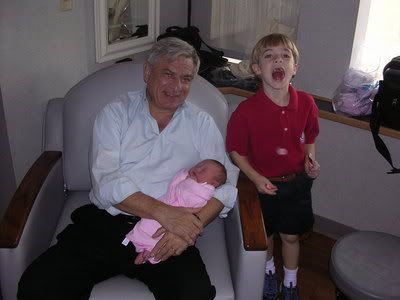
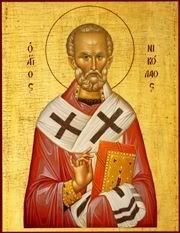
  • Happy Feast Day! Today December 6th is the Feast day of St. Nicholas and name day  of our Bishop Metropolitan Nicholas of Detroit  , my father Nicholas and my 6 year old son Nicholas.


    Xronia Polla!


    babysbirth129.jpg


     May God Grant them Many years!


    SaintNicholas.jpg

    St. Nicholas the Wonderworker and Archbishop of Myra in Lycia

    Saint Nicholas, the Wonderworker, Archbishop of Myra in Lycia is famed as a great saint pleasing unto God. He was born in the city of Patara in the region of Lycia (on the south coast of the Asia Minor peninsula), and was the only son of pious parents Theophanes and Nonna, who had vowed to dedicate him to God.

    As the fruit of the prayer of his childless parents, the infant Nicholas from the very day of his birth revealed to people the light of his future glory as a wonderworker. His mother, Nonna, after giving birth was immediately healed from illness. The newborn infant, while still in the baptismal font, stood on his feet three hours, without support from anyone, thereby honoring the Most Holy Trinity. St. Nicholas from his infancy began a life of fasting, and on Wednesdays and Fridays he would not accept milk from his mother until after his parents had finished their evening prayers.

    From his childhood Nicholas thrived on the study of Divine Scripture; by day he would not leave church, and by night he prayed and read books, making himself a worthy dwelling place for the Holy Spirit. Bishop Nicholas of Patara rejoiced at the spiritual success and deep piety of his nephew. He ordained him a reader, and then elevated Nicholas to the priesthood, making him his assistant and entrusting him to instruct the flock.

    In serving the Lord the youth was fervent of spirit, and in his proficiency with questions of faith he was like an Elder, who aroused the wonder and deep respect of believers. Constantly at work and vivacious, in unceasing prayer, the priest Nicholas displayed great kind-heartedness towards the flock, and towards the afflicted who came to him for help, and he distributed all his inheritance to the poor.

    There was a certain formerly rich inhabitant of Patara, whom St. Nicholas saved from great sin. The man had three grown daughters, and in desparation he planned to sell their bodies so they would have money for food. The saint, learning of the man’s poverty and of his wicked intention, secretly visited him one night and threw a sack of gold through the window. With the money the man arranged an honorable marriage for his daughter. St. Nicholas also provided gold for the other daughters, thereby saving the family from falling into spiritual destruction. In bestowing charity, St. Nicholas always strove to do this secretly and to conceal his good deeds.

    The Bishop of Patara decided to go on pilgrimage to the holy places at Jerusalem, and entrusted the guidance of his flock to St. Nicholas, who fulfilled this obedience carefully and with love. When the bishop returned, Nicholas asked his blessing for a pilgrimage to the Holy Land. Along the way the saint predicted a storm would arise and threaten the ship. St. Nicholas saw the devil get on the ship, intending to sink it and kill all the passengers. At the entreaty of the despairing pilgrims, he calmed the waves of the sea by his prayers. Through his prayer a certain sailor of the ship, who had fallen from the mast and was mortally injured was also restored to health.

    When he reached the ancient city of Jerusalem and came to Golgotha, St. Nicholas gave thanks to the Savior. He went to all the holy places, worshiping at each one. One night on Mount Sion, the closed doors of the church opened by themselves for the great pilgrim. Going round the holy places connected with the earthly service of the Son of God, St. Nicholas decided to withdraw into the desert, but he was stopped by a divine voice urging him to return to his native country. He returned to Lycia, and yearning for a life of quietude, the saint entered into the brotherhood of a monastery named Holy Sion, which had been founded by his uncle. But the Lord again indicated another path for him, “Nicholas, this is not the vineyard where you shall bear fruit for Me. Return to the world, and glorify My Name there.” So he left Patara and went to Myra in Lycia.

    Upon the death of Archbishop John, Nicholas was chosen as Bishop of Myra after one of the bishops of the Council said that a new archbishop should be revealed by God, not chosen by men. One of the elder bishops had a vision of a radiant Man, Who told him that the one who came to the church that night and was first to enter should be made archbishop. He would be named Nicholas. The bishop went to the church at night to await Nicholas. The saint, always the first to arrive at church, was stopped by the bishop. “What is your name, child?” he asked. God’s chosen one replied, “My name is Nicholas, Master, and I am your servant.”

    After his consecration as archbishop, St. Nicholas remained a great ascetic, appearing to his flock as an image of gentleness, kindness and love for people. This was particularly precious for the Lycian Church during the persecution of Christians under the emperor Diocletian (284-305). Bishop Nicholas, locked up in prison together with other Christians for refusing to worship idols, sustained them and exhorted them to endure the fetters, punishment and torture. The Lord preserved him unharmed. Upon the accession of St. Constantine (May 21) as emperor, St. Nicholas was restored to his flock, which joyfully received their guide and intercessor.

    Despite his great gentleness of spirit and purity of heart, St. Nicholas was a zealous and ardent warrior of the Church of Christ. Fighting evil spirits, the saint made the rounds of the pagan temples and shrines in the city of Myra and its surroundings, shattering the idols and turning the temples to dust.

    In the year 325 St. Nicholas was a participant in the First Ecumenical Council. This Council proclaimed the Nicean Symbol of Faith, and he stood up against the heretic Arius with the likes of Sts. Sylvester the Bishop of Rome (January 2), Alexander of Alexandria (May 29), Spyridon of Trimythontos (December 12) and other Fathers of the Council.

    St. Nicholas, fired with zeal for the Lord, assailed the heretic Arius with his words, and also struck him upon the face. For this reason, he was deprived of the emblems of his episcopal rank and placed under guard. But several of the holy Fathers had the same vision, seeing the Lord Himself and the Mother of God returning to him the Gospel and omophorion. The Fathers of the Council agreed that the audacity of the saint was pleasing to God, and restored the saint to the office of bishop.

    Having returned to his own diocese, the saint brought it peace and blessings, sowing the word of Truth, uprooting heresy, nourishing his flock with sound doctrine, and also providing food for their bodies.

    Even during his life the saint worked many miracles. One of the greatest was the deliverance from death of three men unjustly condemned by the Governor, who had been bribed. The saint boldly went up to the executioner and took his sword, already suspended over the heads of the condemned. The Governor, denounced by St. Nicholas for his wrong doing, repented and begged for forgiveness.

    Witnessing this remarkable event were three military officers, who were sent to Phrygia by the emperor Constantine to put down a rebellion. They did not suspect that soon they would also be compelled to seek the intercession of St. Nicholas. Evil men slandered them before the emperor, and the officers were sentenced to death. Appearing to St. Constantine in a dream, St. Nicholas called on him to overturn the unjust sentence of the military officers.

    He worked many other miracles, and struggled many long years at his labor. Through the prayers of the saint, the city of Myra was rescued from a terrible famine. He appeared to a certain Italian merchant and left him three gold pieces as a pledge of payment. He requested him to sail to Myra and deliver grain there. More than once, the saint saved those drowning in the sea, and provided release from captivity and imprisonment.

    Having reached old age, St. Nicholas peacefully fell asleep in the Lord. His venerable relics were preserved incorrupt in the local cathedral church and flowed with curative myrrh, from which many received healing. In the year 1087, his relics were transferred to the Italian city of Bari, where they rest even now (See May 9).

    The name of the great saint of God, the hierarch and wonderworker Nicholas, a speedy helper and suppliant for all hastening to him, is famed in every corner of the earth, in many lands and among many peoples. In Russia there are a multitude of cathedrals, monasteries and churches consecrated in his name. There is, perhaps, not a single city without a church dedicated to him.

    The first Russian Christian prince Askold (+ 882) was baptized in 866 by Patriarch Photius (February 6) with the name Nicholas. Over the grave of Askold, St. Olga (July 11) built the first temple of St. Nicholas in the Russian Church at Kiev. Primary cathedrals were dedicated to St. Nicholas at Izborsk, Ostrov, Mozhaisk, and Zaraisk. At Novgorod the Great, one of the main churches of the city, the Nikolo-Dvorischensk church, later became a cathedral.

    Famed and venerable churches and monasteries dedicated to St. Nicholas are found at Kiev, Smolensk, Pskov, Toropetsa, Galich, Archangelsk, Great Ustiug, Tobolsk. Moscow had dozens of churches named for the saint, and also three monasteries in the Moscow diocese: the Nikolo-Greek (Staryi) in the Chinese-quarter, the Nikolo-Perervinsk and the Nikolo-Ugreshsk. One of the chief towers of the Kremlin was named the Nikolsk.

    Many of the churches devoted to the saint were those established at market squares by Russian merchants, sea-farers and those who traveled by land, venerating the wonderworker Nicholas as a protector of all those journeying on dry land and sea. They sometimes received the name among the people of “Nicholas soaked.”

    Many village churches in Russia were dedicated to the wonderworker Nicholas, venerated by peasants as a merciful intercessor before the Lord for all the people in their work. And in the Russian land St. Nicholas did not cease his intercession. Ancient Kiev preserves the memory about the miraculous rescue of a drowning infant by the saint. The great wonderworker, hearing the grief-filled prayers of the parents for the loss of their only child, took the infant from the waters, revived him and placed him in the choir-loft of the church of Holy Wisdom (Hagia Sophia) before his wonderworking icon. In the morning the infant was found safe by his thrilled parents, praising St. Nicholas the Wonderworker.

    Many wonderworking icons of St. Nicholas appeared in Russia and came also from other lands. There is the ancient Byzantine embordered image of the saint, brought to Moscow from Novgorod, and the large icon painted in the thirteenth century by a Novgorod master.

    Two depictions of the wonderworker are especially numerous in the Russian Church: St. Nicholas of Zaraisk, portrayed in full-length, with his right hand raised in blessing and with a Gospel (this image was brought to Ryazan in 1225 by the Byzantine Princess Eupraxia, the future wife of Prince Theodore. She perished in 1237 with her husband and infant son during the incursion of Batu); and St. Nicholas of Mozhaisk, also in full stature, with a sword in his right hand and a city in his left. This recalls the miraculous rescue of the city of Mozhaisk from an invasion of enemies, through the prayers of the saint. It is impossible to list all the grace-filled icons of St. Nicholas, or to enumerate all his miracles.

    St. Nicholas is the patron of travelers, and we pray to him for deliverance from floods, poverty, or any misfortunes. He has promised to help those who remember his parents, Theophanes and Nonna.

    St. Nicholas is also commemorated on May 9 (The transfer of his relics) and on July 29 (his nativity).

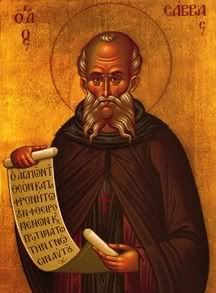
  • Today December 5th, is the Feast day of St. Savas and the name day of our friend Bishop Savas. May God grant him Many Years!


    Venerable Sava the Sanctified


    s.jpg


    Saint Sava the Sanctified was born in the fifth century at Cappadocia of pious Christian parents, John and Sophia. His father was a military commander. Journeying to Alexandria on military matters, his wife went with him, but they left their five-year-old son in the care of an uncle. When the boy reached eight years of age, he entered the monastery of St. Flavian located nearby. The gifted child quickly learned to read and became an expert on the Holy Scriptures. In vain did his parents urge St. Sava to return to the world and enter into marriage.

    When he was seventeen years old he received monastic tonsure, and attained such perfection in fasting and prayer that he was given the gift of wonderworking. After spending ten years at the monastery of St. Flavian, he went to Jerusalem, and from there to the monastery of St. Euthymius the Great (January 20). But St. Euthymius sent St. Sava to Abba Theoctistus, the head of a nearby monastery with a strict cenobitic rule. St. Sava lived in obedience at this monastery until the age of thirty.

    After the death of the Elder Theoctistus, his successor blessed St. Sava to seclude himself in a cave. On Saturdays, however, he left his hermitage and came to the monastery, where he participated in divine services and ate with the brethren. After a certain time St. Sava received permission not to leave his hermitage at all, and he struggled in the cave for five years.

    St. Euthymius attentively directed the life of the young monk, and seeing his spiritual maturity, he began to take him to the Rouba wilderness with him. They set out on January 14, and remained there until Palm Sunday. St. Euthymius called St. Sava a child-elder, and encouraged him to grow in the monastic virtues.

    When St. Euthymius fell asleep in the Lord (+ 473), St. Sava withdrew from the Lavra and moved to a cave near the monastery of St. Gerasimus of Jordan (March 4). After several years, disciples began to gather around St. Sava, seeking the monastic life. As the number of monks increased, a lavra sprang up. When a pillar of fire appeared before St. Sava as he was walking, he found a spacious cave in the form of a church.

    St. Sava founded several more monasteries. Many miracles took place through the prayers of St. Sava: at the Lavra a spring of water welled up, during a time of drought there was abundant rain, and there were also healings of the sick and the demoniacs. St. Sava composed the first monastic Rule of church services, the so-called “Jerusalem Typikon”, accepted by all the Palestine monasteries. The saint surrendered his soul to God in the year 532.

  • Thank you Beth.

    THE DOMESTIC MONASTERY…

    January 7, 2001

    Carlo Carretto, one of the leading spiritual writers of the past half-century, lived for more than a dozen years as a hermit in the Sahara desert. Alone, with only the Blessed Sacrament for company, milking a goat for his food, and translating the bible into the local Bedouin language, he prayed for long hours by himself. Returning to Italy one day to visit his mother, he came to a startling realization: His mother, who for more than thirty years of her life had been so busy raising a family that she scarcely ever had a private minute for herself, was more contemplative than he was.

    Carretto, though, was careful to draw the right lesson from this. What this taught was not that there was anything wrong with what he had been doing in living as a hermit. The lesson was rather that there was something wonderfully right about what his mother had been doing all these years as she lived the interrupted life amidst the noise and incessant demands of small children. He had been in a monastery, but so had she.

    What is a monastery? A monastery is not so much a place set apart for monks and nuns as it is a place set apart (period). It is also a place to learn the value of powerlessness and a place to learn that time is not ours, but God’s.

    Our home and our duties can, just like a monastery, teach us those things. John of the Cross once described the inner essence of monasticism in these words: “But they, O my God and my life, will see and experience your mild touch, who withdraw from the world and become mild, bringing the mild into harmony with the mild, thus enabling themselves to experience and enjoy you.” What John suggests here is that two elements make for a monastery: withdrawal from the world and bringing oneself into harmony with the mild.

    Although he was speaking about the vocation of monastic monks and nuns, who physically withdraw from the world, the principle is equally valid for those of us who cannot go off to monasteries and become monks and nuns. Certain vocations offer the same kind of opportunity for contemplation. They too provide a desert for reflection.

    For example, the mother who stays home with small children experiences a very real withdrawal from the world. Her existence is definitely monastic. Her tasks and preoccupations remove her from the centres of power and social importance. And she feels it. Moreover her sustained contact with young children (the mildest of the mild) gives her a privileged opportunity to be in harmony with the mild, that is, to attune herself to the powerlessness rather than to the powerful.

    Moreover, the demands of young children also provide her with what St. Bernard, one of the great architects of monasticism, called the “monastic bell”. All monasteries have a bell. Bernard, in writing his rules for monasticism, told his monks that whenever the monastic bell rang, they were to drop whatever they were doing and go immediately to the particular activity (prayer, meals, work, study, sleep) to which the bell was summoning them. He was adamant that they respond immediately, stating that if they were writing a letter they were to stop in mid-sentence when the bell rang. The idea in his mind was that when the bell called, it called you to the next task and you were to respond immediately, not because you want to, but because it’s time for that task and time isn’t your time, it’s God’s time. For him, the monastic bell was intended as a discipline to stretch the heart by always taking you beyond your own agenda to God’s agenda.

    Hence, a mother raising children, perhaps in a more privileged way even than a professional contemplative, is forced, almost against her will, to constantly stretch her heart. For years, while raising children, her time is never her own, her own needs have to be kept in second place, and every time she turns around a hand is reaching out and demanding something. She hears the monastic bell many times during the day and she has to drop things in mid-sentence and respond, not because she wants to, but because it’s time for that activity and time isn’t her time, but God’s time. The rest of us experience the monastic bell each morning when our alarm clock rings and we get out of bed and ready ourselves for the day, not because we want to, but because it’s time.

    The principles of monasticism are time-tested, saint-sanctioned, and altogether-trustworthy. But there are different kinds of monasteries, different ways of putting ourselves into harmony with the mild, and different kinds of monastic bells. Response to duty can monastic prayer, a needy hand can be a monastic bell, and working without status and power can constitute a withdrawal into a monastery where God can meet us. The domestic can be the monastic.

  • Well said Crazy Mama.


    The following is a quote by CrazyMamaofMany on the blog of song_of_ascent’s. Emphasis mine.


    “If Christ is the Truth, and the Church, the pillar of truth is suppose to be His very Body, then that says something. If the Holy Trinity is one, and we are suppose to be one with Him and with each other, than that says something.


    The divided condition of Protestantism today did not exist in the first 1500 years of Church history. The sects that did exist were clearly considered to be outside of the Church. And the divisions that occurred, particularly between the east and west, resulted in what both sides historically considered, a separation from the One Holy Catholic and Apostolic Church.


    There is no way modern Protestant interpretation can be supported patristically outside of modern-day Protestantism.”

  • I am posting this article about Holy Communion in the Orthodox Church to continue to answer some of the questions that have recently been asked through e-mail. I hope the readers find it helpful in better understanding Holy Communion and the Divine Liturgy in the Orthodox Church. Please let me know. Also there are a lot of  very good and very informative threads on www.orthodoxchat.com .


    The Holy Eucharist


    Rev. Thomas Fitzgerald


    “We knew not whether we were in heaven or on earth, for surely there is no such splendor or beauty anywhere on earth. We cannot describe it to you; we only know that God dwells there among men and that their Service surpasses the worship of all other places…”


    In the latter part of the tenth century, Vladimir the Prince of Kiev sent envoys to various Christian centers to study their form of worship. These are the words the envoys uttered when they reported their presence at the celebration of the Eucharist in the Great Church of Holy Wisdom in Constantinople. The profound experience expressed by the Russian envoys has been one shared by many throughout the centuries who have witnessed for the first time the beautiful and inspiring Divine Liturgy of the Orthodox Church.

    The Holy Eucharist is the oldest experience of Christian Worship as well as the most distinctive. Eucharist comes from the Greek word which means thanksgiving. In a particular sense, the word describes the most important form of the Church’s attitude toward all of life. The origin of the Eucharist is traced to the Last Supper at which Christ instructed His disciples to offer bread and wine in His memory. The Eucharist is the most distinctive event of Orthodox worship because in it the Church gathers to remember and celebrate the Life, Death, and Resurrection of Christ and, thereby, to participate in the mystery of Salvation.

    In the Orthodox Church, the Eucharist is also known as the Divine Liturgy. The word liturgy means people’s work; this description serves to emphasize the corporate character of the Eucharist. When an Orthodox attends the Divine Liturgy, it is not as an isolated person who comes simply to hear a sermon.

    Rather, he comes as a member of the Community of Faith who participates in the very purpose of the Church, which is the Worship of the Holy Trinity. Therefore, the Eucharist is truly the center of the life of the Church and the principal means of spiritual development, both for the individual Christian and the Church as a whole. Not only does the Eucharist embody and express the Christian faith in a unique way, but it also enhances and deepens our faith in the Trinity. This sacrament-mystery is the experience toward which all the other activities of the Church are directed and from which they receive their direction.

    The Eucharist, the principal sacrament mystery of the Orthodox Church, is not so much a text to be studied, but rather an experience of communion with the Living God in which prayer , music, gestures, the material creation, art and architecture come into full orchestration. The Eucharist is a celebration of faith which touches not only the mind but also the emotions and the senses.

    Throughout the centuries, Christians have seen many dimensions in the Eucharist. The various titles which have come to describe the rite bear witness to the richness of its meaning. The Eucharist has been known as the Holy offering, the Holy Mysteries, the Mystic Supper, and the Holy Communion. The Orthodox Church recognizes the many facets of the Eucharist and wisely refuses to over-emphasize one element to the detirement of the others. In so doing, Orthodoxy has clearly avoided reducing the Eucharist to a simple memorial of the Last Supper which is only occasionally observed. Following the teachings of both Scripture and Tradition, the Orthodox Church believes that Christ is truly present with His people in the celebration of the Holy Eucharist. The Eucharistic gifts of bread and wine become for us His Body and His Blood. We affirm that these Holy Gifts are transfigured into the first fruits of the New Creation in which ultimately God will be “all in all”.

    THREE LITURGIES

    As it is celebrated today, the Divine Liturgy is a product of historical development. The fundamental core of the liturgy dates from the time of Christ and the Apostles. To this, prayers, hymns, and gestures have been added throughout the centuries. The liturgy achieved a basic framework by the ninth century.

    There are three forms of the Eucharist presently in use in the Orthodox Church:

    1. The Liturgy of St. John Chrysostom, which is the most frequently celebrated.


    2. The Liturgy of St. Basil the Great, which is celebrated only ten times a year.


    3. The Liturgy of St. James which is celebrated on October 23, the feastday of the Saint. While these saints did not compose the entire liturgy which bears their names, it is probable that they did author many of the prayers. The structure and basic elements of the three liturgies are similar, although there are differences in some hymns and prayers.

    In addition to these Liturgies, there is also the Liturgy of the Pre-Sanctified Gifts. This is not truly a eucharistic liturgy but rather an evening Vesper Service followed by the distribution of Holy Communion reserved from the previous Sunday. This liturgy is celebrated only on weekday mornings or evenings during Lent, and on Monday, Tuesday, and Wednesday of Holy Week, when the full Eucharist is not permitted because of its Resurrection spirit. The Eucharist expresses the deep joy which is so central to the Gospel.

    The Divine Liturgy is properly celebrated only once a day. This custom serves to emphasize and maintain the unity of the local congregation. The Eucharist is always the principal Service on Sundays and Holy Days and may be celebrated on other weekdays.

    However, the Divine Liturgy is not celebrated by the priest privately, without a congregation. The Eucharist is usually celebrated in the morning but, with the Bishop’s blessing, may be offered in the evening. The Greek Orthodox Archdiocese has recently encouraged the celebration of the Liturgy in the evening after Vespers, on the vigil of major Feast and Saints Days.


    THE ACTIONS OF THE LITURGY


    The Divine Liturgy may be divided into two major parts: the Liturgy of the Catechumens and the Liturgy of the Faithful, which are preceded by the Service of Preparation.

    Although there are many symbolic interpretations of the Divine Liturgy, the most fundamental meaning is found in the actions and prayers.


    THE SERVICE OF PREPARATION


    Prior to the beginning of the Liturgy, the priest prepares himself with prayer and then precedes to vest himself. The vestments express his priestly ministry as well as his office. Next, the priest goes to the Proskomide Table which is on the left side of the Altar Table in the Sanctuary. There, he prepares the offering of bread and wine for the Liturgy. Ideally, the leavened loaves of bread, and the wine from which the offering is taken, are prepared by members of the congregation. The elements are presented to the priest before the service, together with the names of those persons, living and dead, who are to be remembered during the Divine Liturgy. The offering symbolically represents the entire Church gathered about Christ, the Lamb of God.


    THE LITURGY OF THE CATECHUMENS


    The Divine Liturgy begins with the solemn declaration: “Blessed be the Kingdom of the Father and of the Son, and of the Holy Spirit now and for ever more.” With these words we are reminded that in the Divine Liturgy the Church becomes a real manifestation of God’s Kingdom on earth.

    Since the first part of the Liturgy was designed originally for the Catechumens, those being schooled in the faith, had a very instructive quality. The Eucharist also has elements which are in common with other Services. We gather as Christians who share a common faith in the Holy Trinity. We sing and pray as a people united in Christ, who are not bound by time, space, or social barriers.

    The Little Entrance is the central action of the first part of the Liturgy. A procession takes place in which the priest carries the Book of Gospels from the sanctuary into the nave. The procession directs our attention to the Scripture and to the presence of Christ in the Gospel. The entrance leads to the Epistle lesson, the Gospel, and the Sermon.


    THE LITURGY OF THE FAITHFUL


    In the early Church, only those who were baptized and not in a state of sin were permitted to remain for this most solemn part of the Liturgy. With the Great Entrance marking the beginning of this part of the Liturgy, the offering of bread and wine is brought by the priest from the Preparation Table, through the nave, and to the Altar Table. Before the offering can proceed, however, we are called upon to love one another so that we may perfectly confess our faith. In the early Church, the Kiss of Peace was exchanged at this point. After the symbolic kiss of Peace, we join together in professing our Faith through the words of the Creed.

    Only now can we properly offer our gifts of bread and wine to the Father as our Lord directed us to do in His memory. This offering is one of great joy, for through it we remember the mighty actions of God through which we have received the gift of salvation, and especially the Life, Death, and Resurrection of Christ. We invoke the Holy Spirit upon ourselves and upon our offering, asking the Father that they become for us the Body and Blood of Christ. Through our thanking and remembering the Holy Spirit reveals the presence of the Risen Christ in our midst.

    The priest comes from the altar with the Holy Gifts, inviting the congregation to draw near with reverence of God, with faith, and with love.” Our sharing in the Eucharist Gifts not only expresses our fellowship with one another, but also our unity with the Father in His Kingdom. Individuals approach the Holy Gifts and receive the Eucharistic bread and wine from the common chalice. The priest distributes the Holy Gifts by means of a communion spoon. Since the Holy Communion is an expression of our Faith, reception of the Holy Gifts is open only to those who are baptized, chrismated, and practicing members of the Orthodox Church.

    The Liturgy comes to an end with prayer of Thanksgiving and the Benediction. At the conclusion of the Eucharist, the congregation comes forward to receive a portion of the liturgical bread which was not used for the offering.


    “We knew not whether we were in heaven or on earth, for surely there is no such splendor or beauty anywhere on earth. We cannot describe it to you; we only know that God dwells there among men and that their Service surpasses the worship of all other places…”

    In the latter part of the tenth century, Vladimir the Prince of Kiev sent envoys to various Christian centers to study their form of worship. These are the words the envoys uttered when they reported their presence at the celebration of the Eucharist in the Great Church of Holy Wisdom in Constantinople. The profound experience expressed by the Russian envoys has been one shared by many throughout the centuries who have witnessed for the first time the beautiful and inspiring Divine Liturgy of the Orthodox Church.

    The Holy Eucharist is the oldest experience of Christian Worship as well as the most distinctive. Eucharist comes from the Greek word which means thanksgiving. In a particular sense, the word describes the most important form of the Church’s attitude toward all of life. The origin of the Eucharist is traced to the Last Supper at which Christ instructed His disciples to offer bread and wine in His memory. The Eucharist is the most distinctive event of Orthodox worship because in it the Church gathers to remember and celebrate the Life, Death, and Resurrection of Christ and, thereby, to participate in the mystery of Salvation.

    In the Orthodox Church, the Eucharist is also known as the Divine Liturgy. The word liturgy means people’s work; this description serves to emphasize the corporate character of the Eucharist. When an Orthodox attends the Divine Liturgy, it is not as an isolated person who comes simply to hear a sermon.

    Rather, he comes as a member of the Community of Faith who participates in the very purpose of the Church, which is the Worship of the Holy Trinity. Therefore, the Eucharist is truly the center of the life of the Church and the principal means of spiritual development, both for the individual Christian and the Church as a whole. Not only does the Eucharist embody and express the Christian faith in a unique way, but it also enhances and deepens our faith in the Trinity. This sacrament-mystery is the experience toward which all the other activities of the Church are directed and from which they receive their direction.

    The Eucharist, the principal sacrament mystery of the Orthodox Church, is not so much a text to be studied, but rather an experience of communion with the Living God in which prayer , music, gestures, the material creation, art and architecture come into full orchestration. The Eucharist is a celebration of faith which touches not only the mind but also the emotions and the senses.

    Throughout the centuries, Christians have seen many dimensions in the Eucharist. The various titles which have come to describe the rite bear witness to the richness of its meaning. The Eucharist has been known as the Holy offering, the Holy Mysteries, the Mystic Supper, and the Holy Communion. The Orthodox Church recognizes the many facets of the Eucharist and wisely refuses to over-emphasize one element to the detirement of the others. In so doing, Orthodoxy has clearly avoided reducing the Eucharist to a simple memorial of the Last Supper which is only occasionally observed. Following the teachings of both Scripture and Tradition, the Orthodox Church believes that Christ is truly present with His people in the celebration of the Holy Eucharist. The Eucharistic gifts of bread and wine become for us His Body and His Blood. We affirm that these Holy Gifts are transfigured into the first fruits of the New Creation in which ultimately God will be “all in all”.

    THREE LITURGIES

    As it is celebrated today, the Divine Liturgy is a product of historical development. The fundamental core of the liturgy dates from the time of Christ and the Apostles. To this, prayers, hymns, and gestures have been added throughout the centuries. The liturgy achieved a basic framework by the ninth century.

    There are three forms of the Eucharist presently in use in the Orthodox Church:

    1. The Liturgy of St. John Chrysostom, which is the most frequently celebrated.


    2. The Liturgy of St. Basil the Great, which is celebrated only ten times a year.


    3. The Liturgy of St. James which is celebrated on October 23, the feastday of the Saint. While these saints did not compose the entire liturgy which bears their names, it is probable that they did author many of the prayers. The structure and basic elements of the three liturgies are similar, although there are differences in some hymns and prayers.

    In addition to these Liturgies, there is also the Liturgy of the Pre-Sanctified Gifts. This is not truly a eucharistic liturgy but rather an evening Vesper Service followed by the distribution of Holy Communion reserved from the previous Sunday. This liturgy is celebrated only on weekday mornings or evenings during Lent, and on Monday, Tuesday, and Wednesday of Holy Week, when the full Eucharist is not permitted because of its Resurrection spirit. The Eucharist expresses the deep joy which is so central to the Gospel.

    The Divine Liturgy is properly celebrated only once a day. This custom serves to emphasize and maintain the unity of the local congregation. The Eucharist is always the principal Service on Sundays and Holy Days and may be celebrated on other weekdays.

    However, the Divine Liturgy is not celebrated by the priest privately, without a congregation. The Eucharist is usually celebrated in the morning but, with the Bishop’s blessing, may be offered in the evening. The Greek Orthodox Archdiocese has recently encouraged the celebration of the Liturgy in the evening after Vespers, on the vigil of major Feast and Saints Days.


    THE ACTIONS OF THE LITURGY


    The Divine Liturgy may be divided into two major parts: the Liturgy of the Catechumens and the Liturgy of the Faithful, which are preceded by the Service of Preparation.

    Although there are many symbolic interpretations of the Divine Liturgy, the most fundamental meaning is found in the actions and prayers.


    THE SERVICE OF PREPARATION


    Prior to the beginning of the Liturgy, the priest prepares himself with prayer and then precedes to vest himself. The vestments express his priestly ministry as well as his office. Next, the priest goes to the Proskomide Table which is on the left side of the Altar Table in the Sanctuary. There, he prepares the offering of bread and wine for the Liturgy. Ideally, the leavened loaves of bread, and the wine from which the offering is taken, are prepared by members of the congregation. The elements are presented to the priest before the service, together with the names of those persons, living and dead, who are to be remembered during the Divine Liturgy. The offering symbolically represents the entire Church gathered about Christ, the Lamb of God.


    THE LITURGY OF THE CATECHUMENS


    The Divine Liturgy begins with the solemn declaration: “Blessed be the Kingdom of the Father and of the Son, and of the Holy Spirit now and for ever more.” With these words we are reminded that in the Divine Liturgy the Church becomes a real manifestation of God’s Kingdom on earth.

    Since the first part of the Liturgy was designed originally for the Catechumens, those being schooled in the faith, had a very instructive quality. The Eucharist also has elements which are in common with other Services. We gather as Christians who share a common faith in the Holy Trinity. We sing and pray as a people united in Christ, who are not bound by time, space, or social barriers.

    The Little Entrance is the central action of the first part of the Liturgy. A procession takes place in which the priest carries the Book of Gospels from the sanctuary into the nave. The procession directs our attention to the Scripture and to the presence of Christ in the Gospel. The entrance leads to the Epistle lesson, the Gospel, and the Sermon.


    THE LITURGY OF THE FAITHFUL


    In the early Church, only those who were baptized and not in a state of sin were permitted to remain for this most solemn part of the Liturgy. With the Great Entrance marking the beginning of this part of the Liturgy, the offering of bread and wine is brought by the priest from the Preparation Table, through the nave, and to the Altar Table. Before the offering can proceed, however, we are called upon to love one another so that we may perfectly confess our faith. In the early Church, the Kiss of Peace was exchanged at this point. After the symbolic kiss of Peace, we join together in professing our Faith through the words of the Creed.

    Only now can we properly offer our gifts of bread and wine to the Father as our Lord directed us to do in His memory. This offering is one of great joy, for through it we remember the mighty actions of God through which we have received the gift of salvation, and especially the Life, Death, and Resurrection of Christ. We invoke the Holy Spirit upon ourselves and upon our offering, asking the Father that they become for us the Body and Blood of Christ. Through our thanking and remembering the Holy Spirit reveals the presence of the Risen Christ in our midst.

    The priest comes from the altar with the Holy Gifts, inviting the congregation to draw near with reverence of God, with faith, and with love.” Our sharing in the Eucharist Gifts not only expresses our fellowship with one another, but also our unity with the Father in His Kingdom. Individuals approach the Holy Gifts and receive the Eucharistic bread and wine from the common chalice. The priest distributes the Holy Gifts by means of a communion spoon. Since the Holy Communion is an expression of our Faith, reception of the Holy Gifts is open only to those who are baptized, chrismated, and practicing members of the Orthodox Church.

    The Liturgy comes to an end with prayer of Thanksgiving and the Benediction. At the conclusion of the Eucharist, the congregation comes forward to receive a portion of the liturgical bread which was not used for the offering.


    http://www.goarch.org/en/ourfaith/articles/article7077.asp