Month: November 2005

  • Today November 13th  is the feast day of


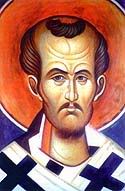
    St. John Chrysostom the Archbishop of Constantinople


    St.jpg

    Happy Name day to our dear friend Chrysostom!

    (Basil lit a candle for you today and remembered you in prayer. We miss you Chyrsostom. Come to America and visit us! Soon!)
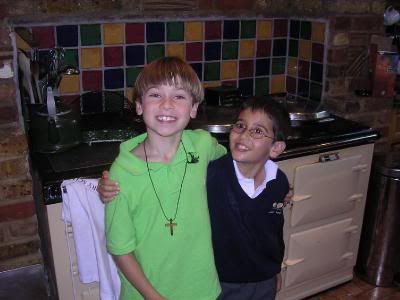

    bandc1.jpg


    (Basil and Chyrsostom  London, Summer of 04.)
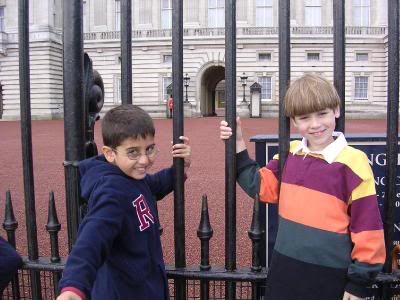
     

    BuckinghamPalace.jpg


    ~May God Grant Many Years to all those that celebrate their feast today!~


    Saint John Chrysostom, Archbishop of Constantinople, one of the Three Hierarchs [January 30], was born at Antioch in about the year 347 into the family of a military-commander. His father, Secundus, died soon after the birth of his son. His mother, Anthusa, widowed at twenty years of age, did not seek to remarry but rather devoted all her efforts to the raising of her son in Christian piety. The youth studied under the finest philosophers and rhetoricians. But, scorning the vain disciplines of pagan knowledge, the future hierarch turned himself to the profound study of Holy Scripture and prayerful contemplation. St. Meletius, Bishop of Antioch (February 12), loved John like a son, guided him in the Faith, and in the year 367 baptized him.

    After three years John was made a church reader. Later on, when St. Meletius had been sent off into exile by the emperor Valens in the year 372, John and Theodore (afterwards Bishop of Mopsuestia) studied under the experienced instructors of ascetic life, the presbyters Flavian and Diodorus of Tarsus. The highly refined Diodorus had particular influence upon the youth. When John’s mother died, he accepted monasticism, which he called the “true philosophy.” Soon John and his friend Basil were being considered as candidates for the episcopal office, and the friends decided to withdraw into the wilderness to avoid this. But St. John, while evading the episcopal rank out of humility, secretly assisted in Basil’s consecration.

    During this period St. John wrote his “Six Discourses on the Priesthood”, a great work of Orthodox pastoral theology. The saint spent four years in the toils of wilderness life, living the ascetic life under the guidance of an experienced spiritual guide. And here he wrote three books entitled, “Against the Opponents of Those Attracted to the Monastic Life”, and a collection entitled, “A Comparison of the Monk with the Emperor” (also known as “Comparison of Imperial Power, Wealth and Eminence, with the True and Christian Wisdom-Loving Monastic Life”), both works which are marked by a profound reflection of the worthiness of the monastic vocation.

    For two years, the saint lived in a solitary cave in complete silence. But the saint was obliged to return to Antioch to recover his health. In the year 381 St. Meletius, the Bishop of Antioch, ordained him deacon. The years following were devoted to work on new theological writings: “Concerning Providence” (“To the Ascetic Stagirios”), “Book Concerning Virginity,” “To a Young Widow” (2 discourses), and the “Book of St. Babylos and Against Julian and the Pagans.”

    In the year 386 St. John was ordained presbyter by Bishop Flavian of Antioch. St. John was a splendid preacher, and for his rare talent with God-inspired words he received from his flock the title, the “Golden-Mouthed” (“Chrysostom”). For twelve years the saint preached in church, usually twice a week, but sometimes daily, deeply stirring the hearts of his listeners.

    In his pastoral zeal to provide Christians with a better understanding of Holy Scripture, St. John employed hermeneutics, an interpretation and analysis of the Word of God (i.e. exegesis”). Among his exegetical works are commentaries on entire books of the Holy Scripture (Genesis, the Psalter, the Gospels of Matthew and John, the Epistles of the Apostle Paul), and also many homilies on individual texts of the Holy Bible, but also instructions on the Feastdays, laudations on the Saints, and also apologetic (i.e. defensive) homilies (against Anomoeans, Judaizers and pagans). St. John as presbyter zealously fulfilled the command of caring for the needy. Under St. John, the Antiochian Church provided sustenance each day to as many as 3,000 virgins and widows, not including in this number the shut-ins, wanderers and the sick.

    At the beginning of Great Lent in 388 the saint began his commentary on the Book of Genesis. Over the forty-day period he preached 32 homilies. During Passion week he spoke about the Betrayal and about the Cross, and during the Paschal Bright Week his parishioners were daily instructed by his pastoral discourse. His exegesis on the Book of Genesis was concluded only at the end of October (388). At Pascha in the following year the saint began his examination of the Gospel of John, and towards the end of the year 389 he took up the Gospel of Matthew. In the year 391 the Antioch Christians listened to his commentary on the Epistles of the holy Apostle Paul to the Romans and to the Corinthians. In 393 he addressed the Epistles to the Galatians, the Ephesians, Timothy, Titus and the Psalms. In his homily on the Epistle to the Ephesians, St. John denounced a schism in Antioch, “I tell you and I witness before you, that to tear asunder the Church means nothing less than to fall into heresy. The Church is the house of the Heavenly Father, One Body and One Spirit.”

    The fame of the holy preacher grew, and in the year 397 with the death of Archbishop Nectarius of Constantinople, successor to St. Gregory the Theologian, St. John Chrysostom was summoned from Antioch, and elected to the Constantinople throne. At the capital, the holy archpastor was not able to preach as often as he had at Antioch. Many matters awaited the saint’s attention, and he began with the most important — with the spiritual perfection of the priesthood. He himself was the best example of this. The financial means apportioned for the archbishop were channelled by the saint into the upkeep of several hospices for the sick and two hostels for pilgrims. The archpastor fasted strictly and ate very little food, and he refused invitations to meals because of his delicate stomach.

    The saint’s zeal in spreading the Christian Faith extended not only to the inhabitants of Constantinople, but also to Thrace to include Slavs and Goths, and to Asia Minor and the Pontine region. He established a bishop for the Bosphorus Church in the Crimea. St. John sent off zealous missionaries to Phoenicia, to Persia, and to the Scythians, to convert pagans to Christ. He also wrote letters to Syria to bring back the Marcionites into the Church, and he accomplished this. Preserving the unity of the Church, the saint would not permit a powerful Gothic military commander, who wanted the emperor to reward his bravery in battle, to open an Arian church at Constantinople. The saint exerted much effort in enhancing the splendor of the church services: he compiled a Liturgy, he introduced antiphonal singing for the all-night Vigil, and he wrote several prayers for the rite of anointing the sick with oil.

    The saintly hierarch denounced the dissolute morals of people in the capital, especially at the imperial court, irrespective of person. When the empress Eudoxia connived to confiscate the last properties of the widow and children of a disgraced dignitary, the saint rose to their defense. The arrogant empress did not concede and nursed a grudge against the archpastor. The hatred of Eudoxia against the saint blazed forth anew when malefactors told her that apparently the saint had her particularly in mind in his sermon on women of vanity. A court was convened composed of hierarchs, who earlier had been justly condemned by Chrysostom: Theophilus of Alexandria, Bishop Severian of Gabala, who shortly before had been banished from the capital because of improprieties, and others.

    This court of judgement declared St. John deposed, and that he be executed for his insult to the empress. The emperor decided on exile instead of execution. An angry crowd surged at the church, resolved to defend their pastor. The saint, in order to avoid a riot, gave himself into the hands of the authorities. That very night at Constantinople there was an earthquake. The terrified Eudoxia urgently requested the emperor to bring the saint back, and promptly sent a letter to the banished pastor, beseeching him to return. Once more, in the capital church, the saint praised the Lord in a short talk, “For All His Ways”.

    The slanderers fled to Alexandria. But after only two months a new denunciation provoked the wrath of Eudoxia. In March of the year 404 an unjust Council gathered, decreeing the exile of St. John. Upon his removal from the capital, a fire reduced the temple of Hagia Sophia to ashes and also the Senate building. Devastating barbarian incursions soon followed, and in October 404 Eudoxia died. Even pagans saw in these events heavenly chastisement for the unjust judgement against the saint of God.

    In Armenia, the saint strove all the more to encourage his spiritual children. In numerous letters (245 are preserved) to bishops in Asia, Africa, Europe and particularly to his friends in Constantinople, St. John consoled the suffering, guiding and giving support to his followers. In the winter of 406 St. John was confined to his bed with sickness, but his enemies were not to be appeased. From the capital came orders to transfer St. John to desolate Pitius in Abkhazia. Worn out by sickness, under military escort for three months in the rain and frost, the saint made his final journey. At Comana, his powers failed him.

    At the crypt of St. Basiliscus (May 22), comforted by a vision of the martyr (“Despair not, brother John! Tomorrow we shall be together”), and having received the Holy Mysteries, the hierarch fell asleep in the Lord on September 14, 407 with the words, “Glory to God for all things!” The holy relics of St. John Chrysostom were solemnly transferred to Constantinople in the year 438. The disciple of St. John, the venerable Isidore Pelusium (February 4), wrote: “The house of David is grown strong, and the house of Saul enfeebled. He is victor over the storms of life, and is entered into Heavenly repose.”

    The memory of St. John Chrysostom is also celebrated on January 27 and January 30 .
  • I am posting Tamara’s thoughts on my last post. Tamara I really appreciate what you had to say here and  having never been Protestant I always learn something new from your  point of view and experiences. Thank you!


    This discussion of miracles was also continued on www.Orthodoxchat.com if you are interested to read more or participate in the conversation  click here.


    The following is a post made by Tamara  on her blog.


    Miracles


    http://www.xanga.com/presvlisa/383908852/item.html


    I just read Pres. Lisa’s post about St. Nektarios.  I remember praying for God to work miracles again, like he used to, miracles that would show the world he is still God.  I’ve heard sermons and revivlas on signs and wonders, and I’ve been to revivals where miracles happen–like, for example, someone with one leg longer than the other watching their own legs “grow” to the same length.  I’ve been told of financial miracles and miracles of God’s provision.  I’ve experienced God’s protection myself, on occasions both known and unknown.  In El Salvador, particularly, we saw many miracles of divine intervention and some healings. 


    I’ve always been a little suspicious of those miracles.  For example, even though I saw that woman’s leg “grow,” I don’t know that I believe she didn’t just adjust how she was sitting.  Maybe she did, maybe she didn’t.  For all the stories of God’s protection, I have at least as many prayer requests for healing after an accident or for some disease.  (Which is not to say that I believe Christians should never suffer danger or disease–I know that we will.)  The girl in El Salvador didn’t have a pulse for several minutes, and then she did.  I know, b/c I’m the one who took her pulse.  Except that I’m not a medical professional, and that my father who is (was) a physician’s assistant told me that it’s possible to push too hard and “miss” the pulse.  Maybe that’s what I did.  Maybe the girl only passed out and then recovered. 


    Do I sound cynical?  I don’t mean to be cynical.  What I’m trying to express is how the miracles I hear about in the Orthodox church seem so much more “real” to me.  Is that because I want to believe them?  How amazing is it that St. Nektarios’s cross was on the hull of the ship?  That’s almost impossible to believe, much less that his prayer was effective to stop a storm.  But it’s a provable miracle.  People were there, saw it happen, reported it and the story goes on.  Are stories of miracles like these embellished in the Orthodox church? 


    What about that one church where the fire is spontaneous?  That happens every year, right?  Obviously, it’s a mystery that can’t be explained away. 


    Miracles in the EOC seem to be of a different calibre than the miracles I’ve heard about.  They seem magnificent, grandiose, decisive….miraculous.  Is it possible for anyone who reads these words to follow my thougths without thinking that I’m belittling the miraculous events outside of the EOC?  I hope so.  Small miracles are still important in the lives of everyday people, right?  I will never forget what it was like to take that girl’s pulse and not find one and then to see her wake up.  We honestly thought she was dead.  We prayed, and she was restored.  Maybe my questions stem from self-doubt:  How could God actually use me in such a way?


    All my life, the miracles we’ve looked for (although not “sought after,” in the sense that we were always seeking God) were new miracles, a new thing from God, something fresh for a new generation.  And what I’m finding in the EOC is that these types of miracles never ceased, never dried up.  All though the history of the church there are amazing people we can look to who have trails of miracles after them, miracles that point to God, not to someone’s “giftedness.” 


    ________________________________


    I can’t understand how divided christendom is that we Westerners don’t hear about things like that church with the spontaneous fire, or icons that weep, or of any of the happenings of Christians around the world.  I think it’s telling that we don’t even see those people as Christians–the only Christian churches in the world are those planted by our American missionaries.  This speaks to my own ignorance of the world, that I never realized there were Christians in the Middle East, except for the precious few who recently converted after the efforts of some missionary.  I never knew that there are entire towns or villages or families who have been Christians (Orthodox Christians) for generations.  I never knew that Ethiopia used to be majority EOC.  All I knew about it is that there are starving children there.  My journey towards Orthodoxy is also a journey towards a wider world view.  I can’t believe that I’ve spent hours debating religious pluralism, whether Muslims, Jews, Buddists, Hindis, and Christians worship the same God and whether they will go to heaven, and yet I never once even heard about Orthodox Christianity. 


    It seems that if all these miracle-seekers and miracle-preachers in protestant America knew that the Orthodox church even existed, then they’d be faced with evidence of continuous miracles since Acts, not the least of which (and certainly most impressive to me) is the preservation of God’s holy Church for over 2000 years. 


    ~~~~~~~~~~~~~~~~~~~~~~~~~~~


    Visit Tamara’s blog to read the comments.


  • Today Novemeber 9th is the feast day of St. Necktarios one of the great saints of our time and one of my personal favorites. I was very blessed to visit his monastery and grave just two years before I found my cancer.  If you haven’t yet read the life story of St. Necktarios  I highly recommend you do.  I believe the prayers of St. Necktarios helped to heal me and for me to be able to cope through my treatment. St. Necktarios’ life is a constant reminder to us and inspiration to us daily as we serve Christ and His Church.


    May God Grant Many Years to those who celebrate their name day today!


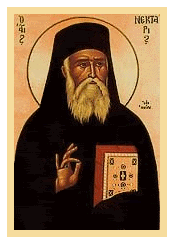
    St. Nectarios pray to God for us!


    St. Nectarios Kephalas the Metropolitan of Pentapolis


    st.gif


    Saint Nectarius, the great wonderworker of modern times, was born Anastasius Kephalas in Selebria, Thrace on October 1, 1846.

    Since his family was poor, Anastasius went to Constantinople when he was fourteen in order to find work. Although he had no money, he asked the captain of a boat to take him. The captain told him to take a walk and then come back. Anastasius understood, and sadly walked away.

    The captain gave the order to start the engines, but nothing happened. After several unsuccessful attempts, he looked up into the eyes of Anastasius who stood on the dock. Taking pity on the boy, the captain told him to come aboard. Immediately, the engines started and the boat began to move.

    Anastasius found a job with a tobacco merchant in Constantinople, who did not pay him very much. In his desire to share useful information with others, Anastasius wrote down short maxims from spiritual books on the paper bags and packages of the tobacco shop. The customers would read them out of curiosity, and might perhaps derive some benefit from them.

    The boy went about barefoot and in ragged clothing, but he trusted in God. Seeing that the merchant received many letters, Anastasius also wanted to write a letter. To whom could he write? Not to his parents, because there were no mail deliveries to his village. Not to his friends, because he had none. Therefore, he decided to write to Christ to tell Him of his needs.

    “My little Christ,” he wrote. “I do not have an apron or shoes. You send them to me. You know how much I love you.”

    Anastasius sealed the letter and wrote on the outside: “To the Lord Jesus Christ in Heaven.” On his way to mail the letter, he ran into the man who owned a shop opposite the one in which he worked. The man asked him where he was going, and Anastasius whispered something in reply. Seeing the letter in his hands, the man offered to mail it for him, since he was on his way to the post office.

    The merchant put the letter in his pocket and assured Anastasius that he would mail it with his own letters. The boy returned to the tobacco shop, filled with happiness. When he took the letter from his pocket to mail it, the merchant happened to notice the address. Astonished and curious, the man could not resist opening the letter to read it. Touched by the boy’s simple faith, the merchant placed some money in an envelope and sent it to him anonymously. Anastasius was filled with joy, and he gave thanks to God.

    A few days later, seeing Anastasius dressed somewhat better than usual, his employer thought he had stolen money from him and began to beat him. Anastasius cried out, “I have never stolen anything. My little Christ sent me the money.”

    Hearing the commotion, the other merchant came and took the tobacco seller aside and explained the situation to him.

    When he was still a young man, Anastasius made a pilgrimage to the Holy Land. During the voyage, the ship was in danger of sinking in a storm. Anastasius looked at the raging sea, and then at the captain. He went and stood beside the captain and took the helm, praying for God to save them. Then he took off the cross his grandmother had given him (containing a piece of the Cross of Christ) and tied it to his belt. Leaning over the side, he dipped the cross into the water three times and commanded the sea, “Silence! Be still.” At once, the wind died down and the sea became calm.

    Anastasius was saddened, however, because his cross had fallen into the sea and was lost. As the boat sailed on, sounds of knocking seemed to come from the hull below the water line. When the ship docked, the young man got off and started to walk away.

    Suddenly, the captain began shouting, “Kephalas, Kephalas, come back here.” The captain had ordered some men into a small boat to examine the hull in order to discover the source of the knocking, and they discovered the cross stuck to the hull. Anastasius was elated to receive his “Treasure,” and always wore it from that time forward. There is a photograph taken many years later, showing the saint in his monastic skufia. The cross is clearly visible in the photo.

    On November 7, 1875, Anastasius received monastic tonsure at the Nea Moni Monastery on Chios, and the new name Lazarus. Two years later, he was ordained a deacon. On that occasion, his name was changed to Nectarius.

    Later, when he was a priest, Fr. Nectarius left Chios and went to Egypt. There he was elected Metropolitan of Pentapolis. Some of his colleagues became jealous of him because of his great virtues, because of his inspiring sermons, and because of everything else which distinguished St. Nectarius from them.

    Other Metropolitans and bishops of the Patriarchate of Alexandria became filled with malice toward the saint, so they told Patriarch Sophronius that Nectarius was plotting to become patriarch himself. They told the patriarch that the Metropolitan of Pentapolis merely made an outward show of piety in order to win favor with the people. So the patriarch and his synod removed St. Nectarius from his See. Patriarch Sophronius wrote an ambiguous letter of suspension which provoked scandal and speculation about the true reasons for the saint’s removal from his position.

    St. Nectarius was not deposed from his rank, however. He was still allowed to function as a bishop. If anyone invited him to perform a wedding or a baptism he could do so, as long as he obtained permission from the local bishop.

    St. Nectarius bore his trials with great patience, but those who loved him began to demand to know why he had been removed. Seeing that this was causing a disturbance in the Church of Alexandria, he decided to go to Greece. He arrived in Athens to find that false rumors about him had already reached that city. His letter of suspension said only that he had been removed “for reasons known to the Patriarchate,” and so all the slanders about him were believed.

    Since the state and ecclesiastical authorities would not give him a position, the former Metropolitan was left with no means of support, and no place to live. Every day he went to the Minister of Religion asking for assistance. They soon tired of him and began to mistreat him.

    One day, as he was leaving the Minister’s office, St. Nectarius met a friend whom he had known in Egypt. Surprised to find the beloved bishop in such a condition, the man spoke to the Minister of Religion and Education and asked that something be found for him. So, St. Nectarius was appointed to be a humble preacher in the diocese of Vitineia and Euboea. The saint did not regard this as humiliating for him, even though a simple monk could have filled that position. He went to Euboea to preach in the churches, eagerly embracing his duties.

    Yet even here, the rumors of scandal followed him. Sometimes, while he was preaching, people began to laugh and whisper. Therefore, the blameless one resigned his position and returned to Athens. By then some people had begun to realize that the rumors were untrue, because they saw nothing in his life or conversation to suggest that he was guilty of anything. With their help and influence, St. Nectarius was appointed Director of the Rizarios Seminary in Athens on March 8, 1894. He was to remain in that position until December of 1908.

    The saint celebrated the services in the seminary church, taught the students, and wrote several edifying and useful books. Since he was a quiet man, St. Nectarius did not care for the noise and bustle of Athens. He wanted to retire somewhere where he could pray. On the island of Aegina he found an abandoned monastery dedicated to the Holy Trinity, which he began to repair with his own hands.

    He gathered a community of nuns, appointing the blind nun Xenia as abbess, while he himself served as Father Confessor. Since he had a gift for spiritual direction, many people came to Aegina to confess to him. Eventually, the community grew to thirty nuns. He used to tell them, “I am building a lighthouse for you, and God shall put a light in it that will shine forth to the world. Many will see this light and come to Aegina.” They did not understand what he was telling them, that he himself would be that beacon, and that people would come there to venerate his holy relics.

    On September 20, 1920 the nun Euphemia brought an old man in black robes, who was obviously in pain, to the Aretaieion Hospital in Athens. This was a state hospital for the poor. The intern asked the nun for information about the patient.

    “Is he a monk?” he asked.

    “No, he is a bishop.”

    The intern laughed and said, “Stop joking and tell me his name, Mother, so that I can enter it in the register.”

    “He is indeed a bishop, my child. He is the Most Reverend Metropolitan of Pentapolis.”

    The intern muttered, “For the first time in my life I see a bishop without a panagia or cross, and more significantly, without money.”

    Then the nun showed the saint’s credentials to the astonished intern who then admitted him. For two months St. Nectarius suffered from a disease of the bladder. At ten thirty on the evening of November 8, 1920, he surrendered his holy soul to God. He died in peace at the age of seventy-four.

    In the bed next to St. Nectarius was a man who was paralyzed. As soon as the saint had breathed his last, the nurse and the nun who sat with him began to dress him in clean clothing to prepare him for burial at Aegina. They removed his sweater and placed it on the paralyzed man’s bed. Immediately, the paralytic got up from his bed, glorifying God.

    St. Nectarius was buried at the Holy Trinity Monastery on Aegina. Several years later, his grave was opened to remove his bones (as is the custom in Greece). His body was found whole and incorrupt, as if he had been buried that very day.

    Word was sent to the Archbishop of Athens, who came to see the relics for himself. Archbishop Chrysostomos told the nuns to leave them out in the sun for a few days, then to rebury them so that they would decay. A month or two after this, they opened the grave again and found the saint incorrupt. Then the relics were placed in a marble sarcophagus.

    Several years later, the holy relics dissolved, leaving only the bones. The saint’s head was placed in a bishop’s mitre, and the top was opened to allow people to kiss his head.

    St. Nectarius was glorified by God, since his whole life was a continuous doxology to the Lord. Both during his life and after his death, St. Nectarius has performed thousands of miracles, especially for those suffering from cancer. There are more churches dedicated to St. Nectarius than to any other modern Orthodox saint.


    Glory Be to God for all things!


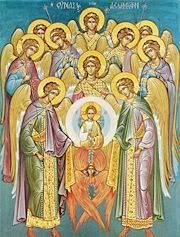
  • Archangel Michael & the other Bodiless Powers: Gabriel, Raphael, Uriel, Salaphiel, Jegudiel, & Barachiel


    Today is the name day of our little Maria~Angelica (she will also celebrate on November 21 The Entranceof the Theotokos into the Temple) , my mother Angeliki, my goddaughter Angelika,  and my brother Michael. Happy Name Day. May the Holy Angels continue to bless and protect you always.


    _synaxis_archangels.jpg


    May God grant all those that celebrate their name day today   Many Years!!!


    Apolytikion for the Archangels in tone 4


    “O Commanders of the Heavenly Host, we the unworthy beseech you, that through your entreaties you will fortify us, guarding us in the shelter of the wings of your ethereal glory, even as we fervently bow before you crying: “Deliver us from all danger, as Commanders of the Powers on high! “


    michael_gabriel.jpg


    Description of the Feast

    All the Angels, according to the Apostle Paul, are ministering spirits, – sent forth to minister to them who shall be heirs of salvation – (Heb. 1:14). God set them as overseers of every nation and people, and guides to that which is profitable (Deut. 32:8); and while one Angel is appointed to oversee each nation as a whole, one is also appointed to protect each Christian individually. He commands them to guard them that hope on Him, that nothing should harm them, neither should any evil draw nigh to their dwelling (Ps. 90:10-12). In the Heavens they always behold the face of God, sending up to Him the thrice-holy hymn and interceding with Him in our behalf, seeing they rejoice over one sinner that repents (Esaias 6:2-3; Matt. 18:10; Luke 15:7). In a word, they have served God in so many ways for our benefit, that the pages of Holy Scripture are filled with the histories thereof. It is for these reasons that the Orthodox Catholic Church, wisely honouring these divine ministers, our protectors and guardians, celebrates today the present Synaxis that is, our coming together in assembly for their common feast to chant their praises, especially for the Archangels Michael and Gabriel, who are mentioned in the Scriptures by name. The name Michael means “Who is like God?” and Gabriel means “God is mighty.” The number of Angels is not defined in the divine Scriptures, where Daniel says that thousands of thousands ministered before Him, and ten thousands of ten thousands attended upon Him -(Dan. 7:10). But all of them are divided into nine orders which are called Thrones, Cherubim, Seraphim, Dominions, Powers, Authorities, Principalities, Archangels, and Angels.


    http://www.goarch.org/

  •  


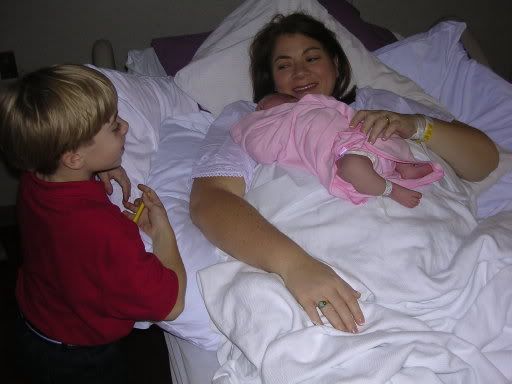
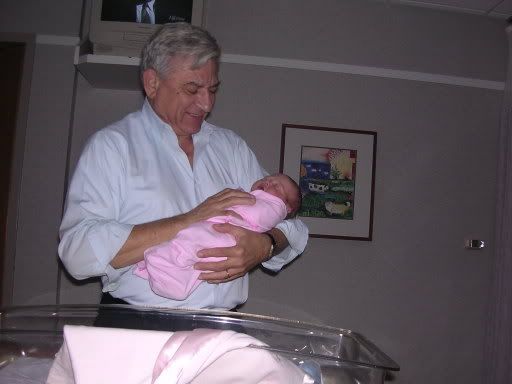
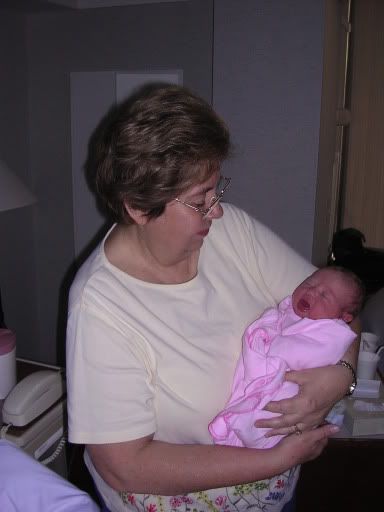
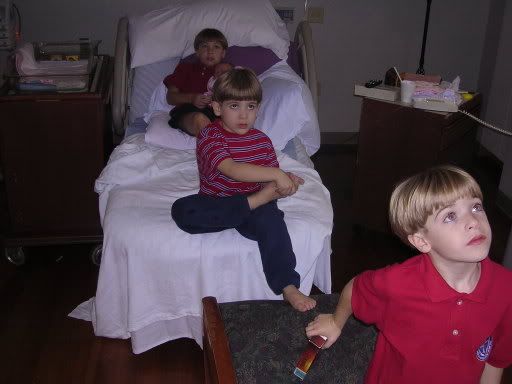
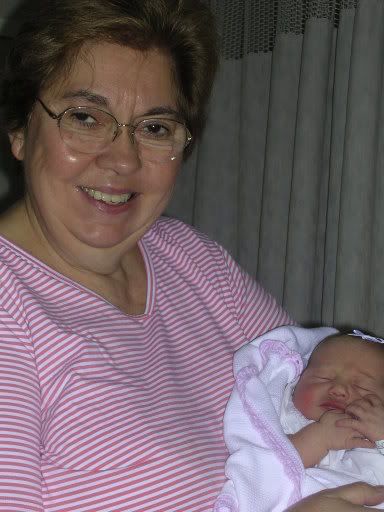
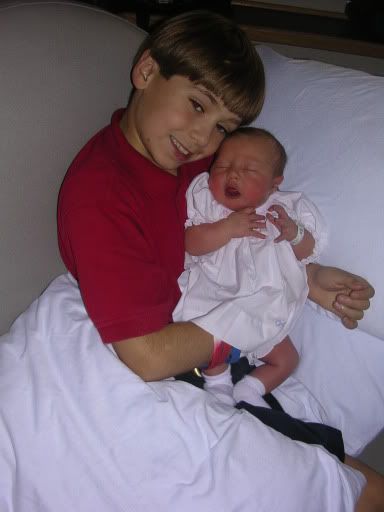
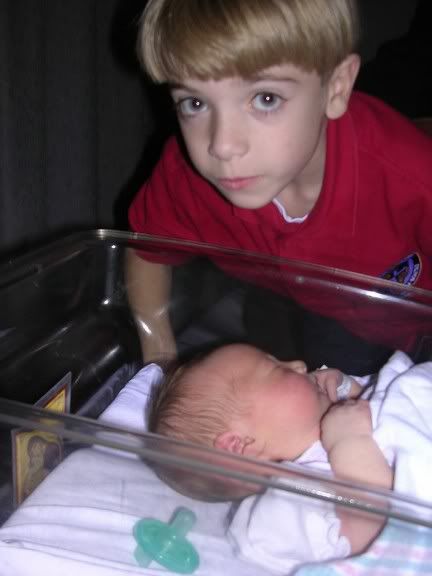
    babysbirth032.jpg


    babysbirth033.jpg


    babysbirth034.jpg


    babysbirth037.jpg


    babysbirth042.jpg


    babysbirth035.jpg


    babysbirth006.jpg


    babysbirth047.jpg


    babysbirth058.jpg


    babysbirth089.jpg


    babysbirth090.jpg


    babysbirth068.jpg


    babysbirth080.jpg


    babysbirth084.jpg


    babysbirth087.jpg


    babysbirth104.jpg


    babysbirth109.jpg


    babysbirth134.jpg


    babysbirth118.jpg


    babysbirth116.jpg


    babysbirth133.jpg


    babysbirth114.jpg


    babysbirth111.jpg


    babysbirth174.jpg


    babysbirth213.jpg


    babysbirth177.jpg

    babysbirth175.jpg


    babysbirth205.jpg


    babysbirth218.jpg


    babysbirth208.jpg


    babysbirth172.jpg


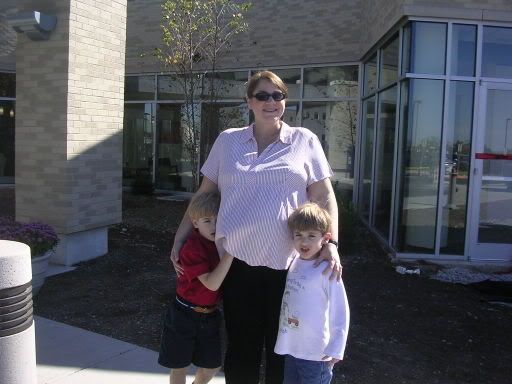
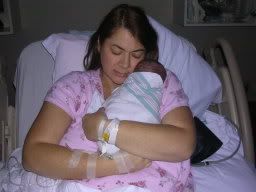
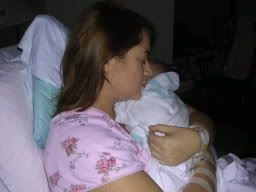
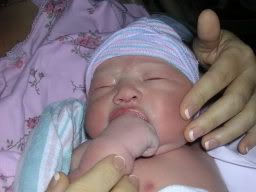
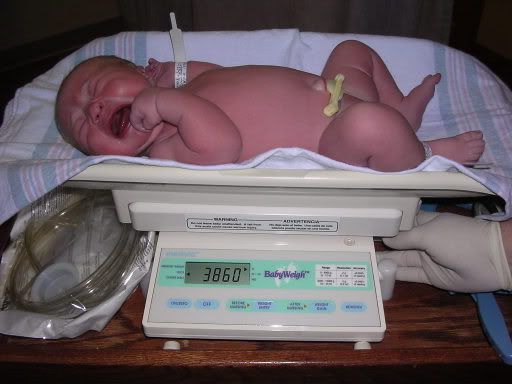
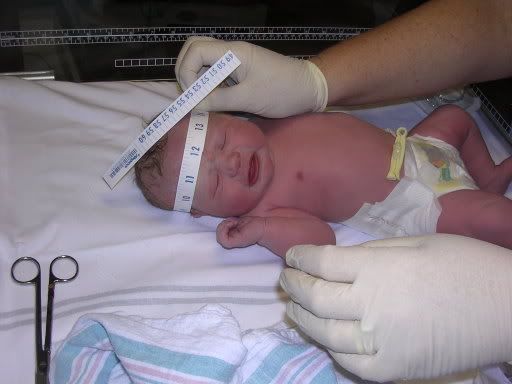
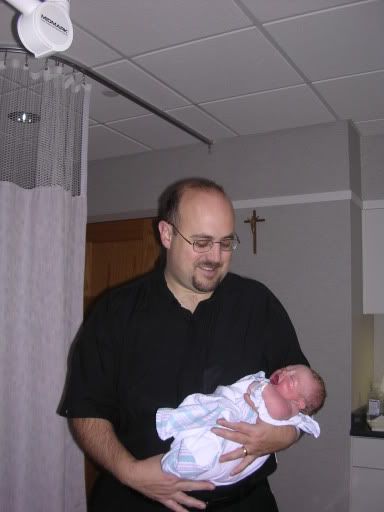
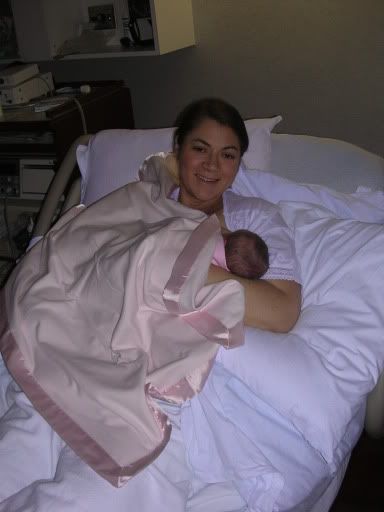
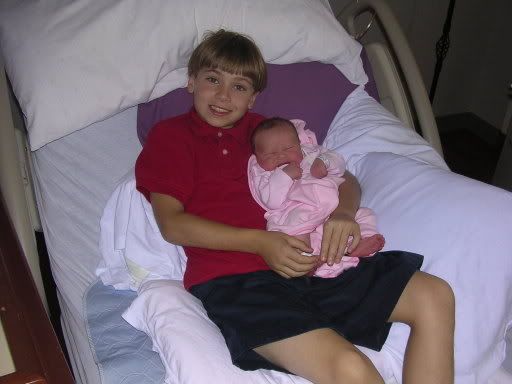
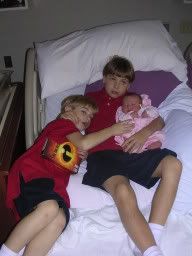
  • Hello everyone,  I am not up and around much yet. I am still real sore from the surgery and just trying to concentrate on feeding the baby and resting when she rests. ( I didn’t sleep much at all in the hospital, either week.)  Maria~Angelica is a really great little baby and the boys are enjoying her so much, as are Fr. and I.  I am sorry I haven’t been able to answer e-mails in a long time. Thank you all for your wonderful gifts and cards, they mean so much to us!!


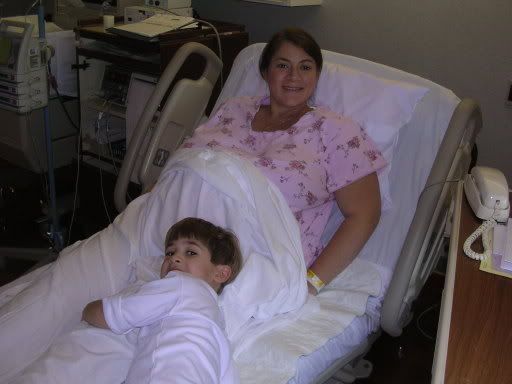
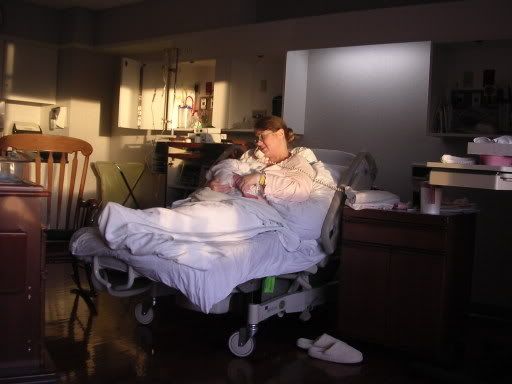
     The weekend that we brought the baby home I just wasn’t feeling right at all. I called my Dr. and although she thought I sounded well, and not winded,  she suggested I come to the ER on that first Saturday so that she could see me in person, although she wasn’t panicked. I  wasn’t up for even doing that and I really didn’t like the thought of taking a  4 day old baby with me to the ER, which I would have to do as I am nursing her. So I thought I would just ride it out and hope that I would soon feel better. Although the symptoms I was feeling were not familiar postpartum symptoms.  I called the Dr. again on Monday and finally on Tuesday I went in for an appt. Immediately she sent me to the hospital. I was very swollen in my legs and I couldn’t breathe. I was sent for and echo cardiogram first thing, which checked out fine.  Then later that night after my blood counts came back showing that my red count was very low ( lower then usual, I am anemic to begin with, due to the cancer treatment)  I was given two units of blood ,which took until 5 in the morning, but eventually helped my breathing. Somewhere during the blood transfusions, around 1:30 am I went for a CT scan. Then next morning during rounds, the hematologist, cardiologist, pulmonologist, gynecologist and the hospitalists all appeared. Needless to say I got a very good check up.  That day more test were ordered, including a test to look for blood clots in my legs a scan of  my gallbladder and a CT scan to my head. The next day the surgeon showed up to say I need to have my gallbladder taken out  or I would never feel better. I hadn’t had experienced any pain due to my gallbladder, but the days were passing and I wanted to get out of the hospital, I was feed up with IVs and trying to find a vein. I was also very much missing  the boys and my own bed.  Not all the nurses were so supportive of nursing and having the baby with me. Many nurses and all the doctors were very nice and very supportive. 


    I was very much dreading having surgery. Thankfully I had a great surgeon and lots of help.   


    During the surgery a good friend from Church, who is a pediatric nurse practioner  came by to stay with the baby and feed her the pumped milk so that Fr. could be able to talk to the surgeon etc… Having our friend there with the baby really put my mind at ease.  My parents and brother were busy at my parents home entertaining the boys. Uncle Michael made some very nice carved pumpkins for the boys.  Also one night during our hospital stay the Dr. that treatment me for my Hodgkin’s all those years ago surprised us with  a social call, which was very , very nice of him. His colleague was treating me as I was not at the hospital where he sees patients.  On my last day some good friends from church came by for a visit and brought some lovely presents for Maria~Angelica and me. 


    In the meantime, while I was in the hospital,  I learned that a family that I knew from a  parenting board had lost their little baby. She had been born sickly and we were all praying for her and her family. I am really very, very, very  sad about the loss of little Rebecca her parents are so  young and have been through so much. Please keep Dan and Adrienne and family in your prayers.


     May Rebecca’s memory be eternal!


    Here is a website in Rebecca’s memory.


    Rebecca Danielle Dennison


    10/28/2005


    Rebecca Danielle Dennison, 8 months, 3 days, died October 25, 2005 in Valencia, CA unexpectedly after a lengthy illness. She was born on February 22, 2005 in Los Angeles, CA.
        
        She is survived by her parents, Dan and Adrienne Dennison of Santa Clarita, CA; maternal grandparents, Gwen and Glenn Sperbeck of Los Angeles, CA and William and Felicidad Foreman of Oxnard, CA; paternal grandparents, Jim and Mardell Dennison of Canyon Country, CA and John and Florence Banga of Grand Rapids, MI; maternal great grandparents, Thomas and Moira McGrath of San Diego, CA;  maternal aunt, Kristina Sperbeck of Los Angeles, CA and maternal uncle, Weston Sperbeck, Los Angeles, CA.
        
        Services will be held on Saturday, October 29, 2005 at 10:00 a.m. at Santa Clarita Baptist Church, 27249 Luther Drive, Santa Clarita, 91351.
        
        Rebecca’s parents wrote, “Rebecca was an ambassador for Christ whose mission was short, sweet and powerful. We praise the Lord for her time with us, for the people who heard the truth of the gospel because of her, and for the glorious truth that she awaits us in Heaven.”
        
        In lieu of flowers or gifts, please consider a donation in Rebecca’s honor to the Los Angeles Ronald McDonald House, the CTICV at Children’s Hospital Los Angeles or Kaiser Foundation Pediatrics.
        
        
    The Signal, Santa Clarita, October 28, 2005


    A Poem for Rebecca by Kelly Reb.


    Sweet Becca Bun
    Oct. 26 2005
    Kelly Reb

    Sweet Becca Bun, precious little one
    your suffering on earth is done.
    You have fought the good fight and run the final race.
    Forever you will be your parent’s trophy of God’s grace.

    So precious, So tiny
    So tender, So sweet
    Now you sit at Jesus’ feet.

    Giggling, Crawling
    Squealing with delight.
    Perfect , Whole
    Your eyes full of sight.

    We are hurting and don’t understand,
    Yet we know this has come
    from the Father’s loving hand.
    As much as we love you,
    He loves you more.
    You are His and were only on loan.
    Now you wear your crown and sit at his throne.

    His Love, His Strength
    His Mercy, His Grace
    Will get us through until we again see your face.

    In that day
    sweet Becca Bun, precious little one
    We will see you
    Whole, Perfect, Complete
    we will all worship together at Jesus’ feet.

    I can see now the line
    as far as the eye can see,
    people wanting to share their story.
    The story of how one precious baby played such a part
    in helping them to give Jesus their heart.

    Little one, your life was not in vain.
    The suffering, the sorrow, the pain,
    all had a purpose you see,
    Yes God used your little life mightily.

    We are grieving, it hurts so much.
    Yet we rejoice because you have been healed by the Master’s touch.
    This isn’t the outcome we desired by far,
    Yet we rejoice little one because we know exactly where you are
    In the palm of His hand, bouncing on His knee.

    We know this is not
    goodbye Becca Bun,
    Your life is not over,
    For it has just Begun.